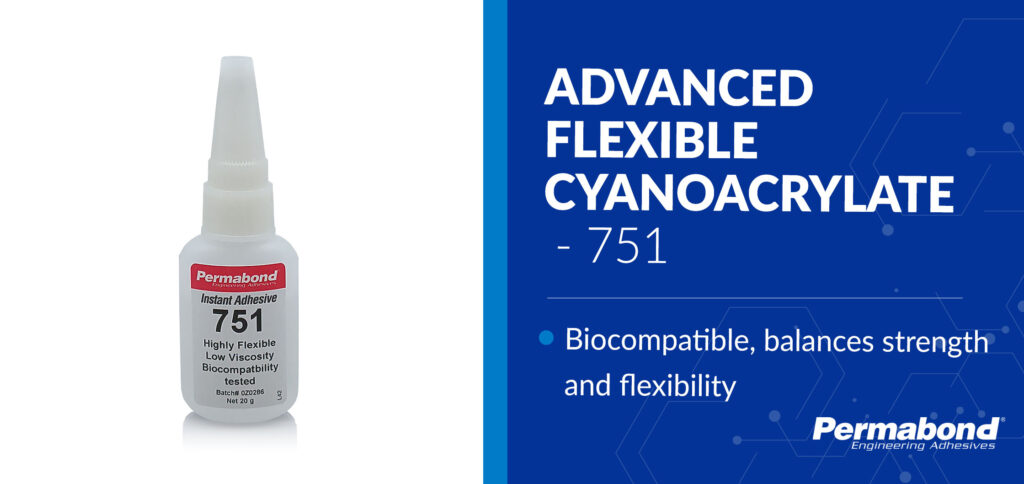
Permabond 751 is a new, advanced flexible cyanoacrylate developed using the latest in adhesive technology. Offering an optimal balance between flexibility and strength, 751 is suitable for use in many adhesive applications and stands out for its biocompatibility.
The right balance of flexibility and strength
In an ideal world, many would want an adhesive that offers both very high flexibility and outstanding strength properties. Unfortunately, particularly with a cyanoacrylate adhesive, this isn’t really possible. Gains made in strength often come at the expense of adhesive flexibility, and vice versa. More flexible adhesives (due to their higher elongation at break) have fewer crosslinks in their structure and a lower tensile modulus, which is what allows them to flex and stretch under duress. On the other hand, these characteristics make them less able to withstand higher shear forces.
However, what if you didn’t have to compromise? Permabond 751 strikes the ideal balance between flexibility and strength. With an elongation at break of 150% and a shear strength higher than 10 N/mm2 (1500 psi) on metals, you have a product that is both strong and with the flexibility to withstand impact, movement and vibration.
Benefits of using a flexible adhesive
Adhesives offering flexibility and elasticity (via their high elongation at break) have several advantages over less flexible products. Their main benefit lies in offering durability – aka resistance – to several important factors. Permabond 751, for example, has very good impact and vibration resistance – crucial for many applications, such as in the automotive industry.
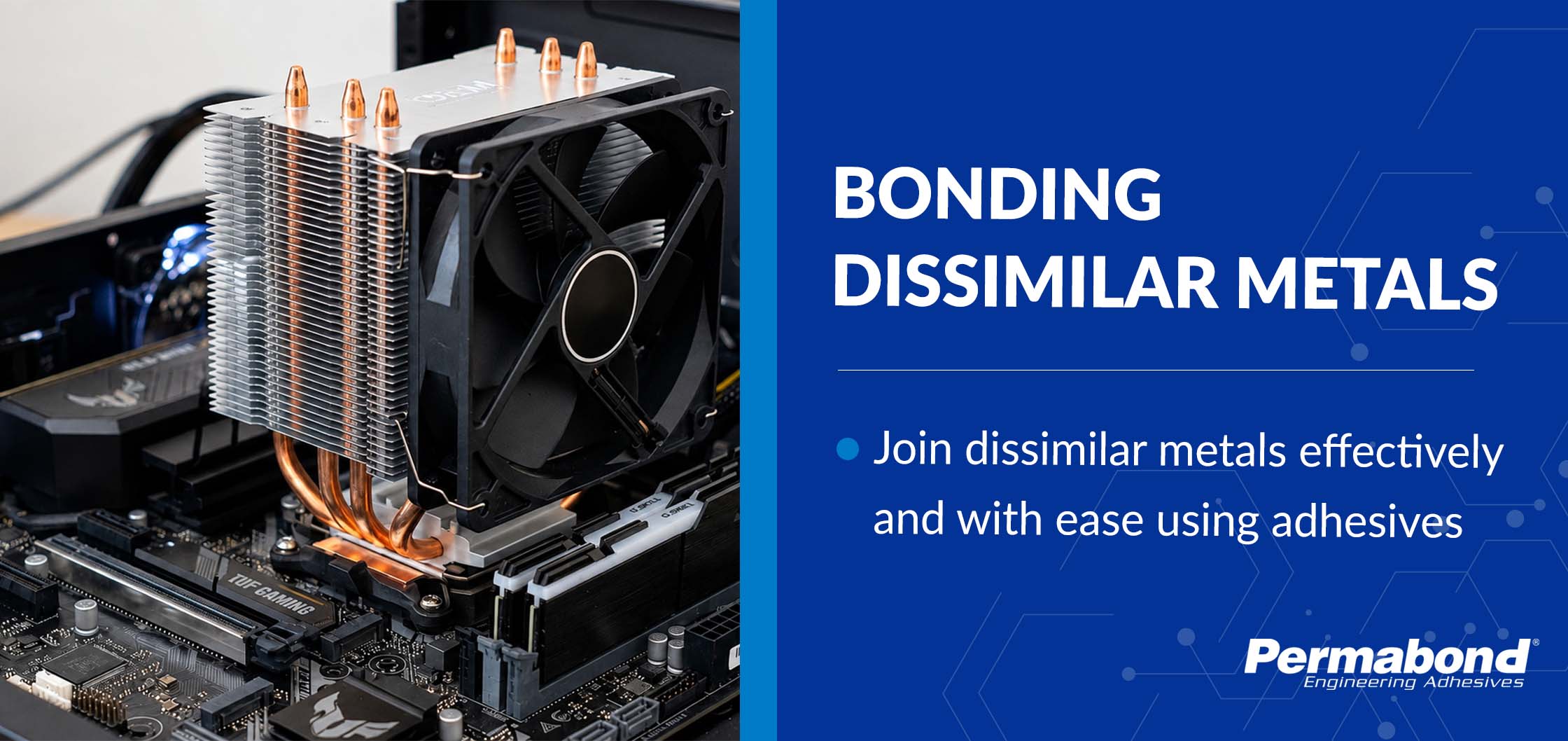
751 also offers resistance to thermal shock and thermal cycling, where a product is subjected to hot and cold cycles. This ability makes it highly suited to bonding dissimilar substrates, for example metals to plastics. Since these materials have vastly different coefficients of thermal expansion (CTE), they expand and contract at very different rates due to heat and cold. A flexible adhesive adjusts much more easily to these different changes in state than a more rigid product would, ensuring a stronger, long-lasting bond.
Passes cytotoxicity testing and great on medical device plastics
Another benefit of Permabond 751 is its biocompatibility. Since the adhesive passes ISO 10993-5 cytotoxicity tests, it is well suited to bonding medical devices. Further strengthening this is that the adhesive performs well on a number of plastics used in the medical field, such as polycarbonate, PVC and ABS. If you have a medical device bonding application where good strength and flexibility are needed, look no further than Permabond 751.
Surface-insensitive cure
A key feature of Permabond 751 is its surface-insensitive curing. Many cyanoacrylate adhesives struggle to cure on certain surfaces. For example, acidic surfaces or those with low moisture frequently present a challenge to these products, especially since cyanoacrylates rely on moisture to fully cure.
751 is surface-insensitive, meaning it will cure fully on a wide variety of surfaces – even low-moisture or acidic ones. This means that substrates such as wood, leather and certain plastics like polypropylene can all be bonded well with this adhesive.
Note: When bonding thin substrates or rubbers with cyanoacrylates, sometimes a crackling sound can be heard if the substrates are bent after curing. This crackling does not mean that the bond is failing and doesn’t adversely affect the durability of the bond over time.
Key Features of Permabond 751
Below, we summarize the key features of this flexible cyanoacrylate adhesive.
- Highly flexible with good strength
- Bonds to challenging plastics like PP (with POP Primer) and PC
- Single-part (no mixing required)
- Solvent-free – reduces workplace hazards
- No curing equipment required (no heat or UV needed)
- Good environmental resistance
- Good shock, impact and vibration resistance
- Thermal shock resistance
- Biocompatible – ISO 10993-5 (cytotoxicity) test pass
- Suitable for dissimilar materials (handles differences in CTE)
If you’d like to find out more about this adhesive or to discuss sampling, please get in touch with us.
Let’s Discuss Your Project.
"*" indicates required fields
Products
Technical Support

Permabond will help you select the right adhesive for your application.