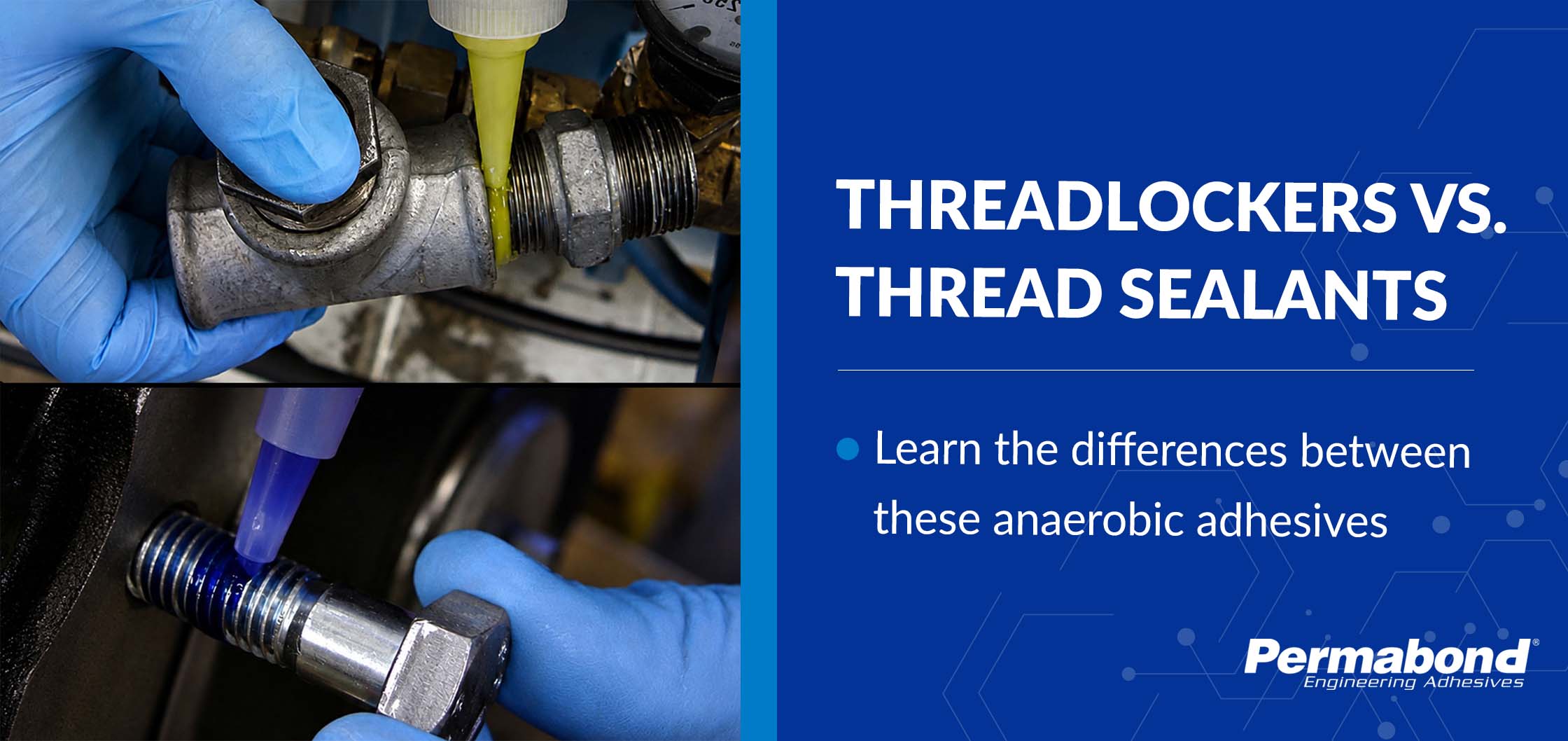
Two bolts fail on the same machine in the same week, and neither was assembled with an anaerobic adhesive. One backs itself out of a housing that vibrates all day. The other stays put but weeps coolant from the threads. Same fastener, same torque spec, two completely different problems. The fix for one is not automatically the fix for the other.
That’s the practical difference between a threadlocker and a thread sealant. Both are anaerobic adhesives, both cure in the absence of air between close-fitting metal parts. Both come out of a bottle looking more or less the same. What separates them is the job they’re being asked to do: hold or seal. Understanding which one your assembly actually needs and recognizing the cases where a single product can do both saves a surprising amount of warranty cost.
What does a threadlocker do?
A threadlocker’s purpose is to stop a fastener from coming loose. Once applied to the threads and assembled, it cures into a hard thermoset that fills the gap between the male and female threads. This does three things at once: it prevents vibration from causing a bolt to back out, it stops the fastener from relaxing under thermal cycling, and it seals out moisture that may cause corrosion in the thread flanks.
A number that many engineers care about is off-torque, and this comes in two parts. Breakaway torque is the maximal effort needed to get a locked fastener moving for the first time. Prevailing torque is what it takes to keep that fastener turning through the rest of the thread engagement, once the initial bond has been broken. The breakaway value tells you how hard the joint resists that first movement. The prevail value tells you how much resistance is left after movement has started. This is the better guide to whether a fastener will keep backing off under sustained vibration. On many anaerobic adhesive grades, the prevail figure is the higher of the two, so that if a bolt starts to move, it does not then run free.
Anything on a pump, a gearbox, a compressor, a conveyor, or a piece of mobile equipment is a potential candidate for an anaerobic adhesive -anywhere the fastener is doing structural work and vibration is part of its daily life.
What does a thread sealant do?
A thread sealant’s purpose is to prevent fluid or gas from leaking through the small gaps in threaded pipe connections. An anaerobic sealant fills these gaps and cures solid, blocking any leak pathways.
This is where anaerobic adhesives beat PTFE tape and pipe dope on a production line. Tape shreds and contaminates hydraulic systems. Dope creeps under pressure and needs retightening. A cured anaerobic sealant doesn’t shred, doesn’t creep, and doesn’t need a second pass after a week of thermal cycling. It also locks the fitting at the same time. This matters when you don’t want a pressure gauge slowly rotating out of alignment.
The overlap: where one product does both jobs
Here’s what makes the “threadlocker vs. thread sealant” framing a bit misleading. Both products essentially work the same way. A liquid flows into the clearance (gap) between mating threads and cures into a solid. Filling that clearance is what stops a fastener from moving. It is also what blocks the path a fluid would otherwise leak through. One mechanism – two useful results, which is why most anaerobic threadlockers will seal and most anaerobic sealants will lock. The label on the bottle tells you which of those two properties the formulation was optimized for, not the only thing it can do.
What actually changes between products is viscosity and rheology, gap-filling capability, cure speed, final strength, and any approvals attached to the product. Choose against those variables rather than the label. One product will often cover more of your bill of materials than you expected.
Frequently asked questions
Below are some questions we are frequently asked about using threadlocker vs. thread sealant.
-
Can I use a threadlocker as a thread sealant?
Often, yes. Anaerobic threadlockers fill and cure in the thread’s leak path, so they seal as well as lock.
Threadlockers tend to be lower viscosity, because screws and bolts have smaller threads than pipe fittings. They also tend to be higher strength, although there are exceptions such as LM113 for small screws and soft metals. Thread sealants tend to be higher viscosity to fill the larger gaps in bigger threaded pipe joints, and slower to fixture so there is time to adjust the joint before the adhesive sets (MH052 is an exception).
For example, Permabond threadlocker HM118 is a high-strength, medium-viscosity anaerobic adhesive that has been trusted for years as a commercial refrigerant sealant, holding against refrigerants including certain Freons and CO2. It is chosen for its ability to lock against vibration loosening as much as for its resistance to refrigerants. Apply it to an overhead fastener or into a blind hole, and it stays where you put it instead of running to the bottom of the hole before you can assemble.
It works the other way round too. Permabond thread sealant MH052 is most often used to seal coolant lines in data centers, but it is equally a trusted refrigerant sealant. Data center coolant sealing and refrigerant sealing have the same purpose: sealing threads to prevent leaks. However, the fluid, pipe size, thread size, metal and system pressure vary between the two. The main factors driving selection are joint/thread size, strength requirements (i.e. is it a permanent assembly, or will the parts be serviced in future?), and environmental conditions (temperature and fluid exposure). If the gap is too wide or the pressure too high for a threadlocker to handle, use a purpose-formulated pipe sealant.
-
Will a thread sealant stop bolts vibrating loose?
Anaerobic thread sealants are designed to provide strength to prevent loosening, but they’re usually formulated at lower strength to allow for easier future servicing. Where a joint needs both a seal and a stronger, long-lasting bond, Permabond HH131 is worth considering: it is a high-strength threadlocker, and is viscous enough to seal many pipe connections as well. For structural fasteners under vibration, choose a product based on off-torque.
-
Do anaerobic adhesives work on stainless steel?
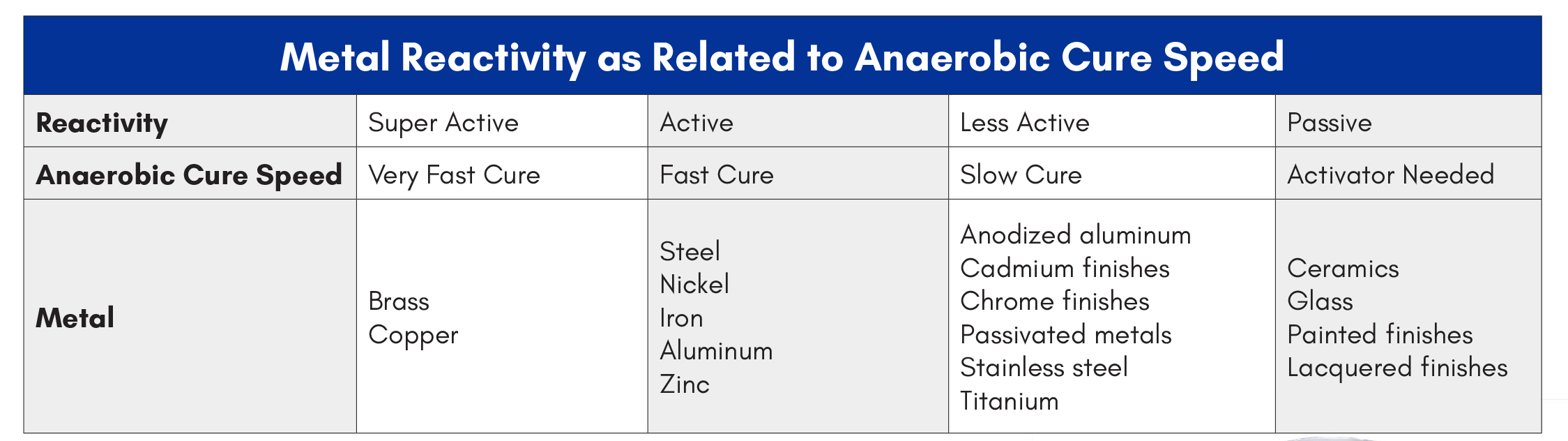
Yes, but more slowly. Anaerobics cure when there is an absence of air and the presence of metal ions on the surface to start the reaction. Steel and brass release those ions readily; stainless steel’s passive oxide layer, zinc plating and anodizing don’t, so cure slows or, in some joints, stalls short of full strength. An activator such as Permabond A905 or ASC10 supplies that missing chemistry. Wipe it on one surface, let it flash off, and cure speed on stainless comes back up.
In many adhesive and sealant applications, engineers are looking for the fastest solution. With thread sealants, a delayed cure is often preferred. So there is time to align the pipes properly before the adhesive fixtures. Where speed does matter on stainless steel, a stainless-specific grade such as Permabond LH150 will fixture faster than grades like LH050, and if ease of removal isn’t a concern, Permabond MH052 is another option that cures well on stainless.
-
How long before the assembly can be handled?
Check the fixture time on the technical datasheet for the grade you are using. Note that the published figure is generally for steel at room temperature with the appropriate thread size. Changing the substrate, the gap being filled, or the temperature will alter this. It is also worth remembering that with sealants, reaching fixture strength does not necessarily mean the joint is ready to face the pressure of a refrigerant or other fluid. For this, we would recommend waiting until a full cure has been achieved.
Still weighing your options for a specific joint? Send us details about your substrates, the gap size, the fluid, and the service temperature of the joint. Permabond’s technical team will point you to the right grade. Contact us or request a sample.!

Permabond le ayudará a elegir el adhesivo correcto para su aplicación.

Los productos Permabond se comercializan a través de distribuidores en todo el mundo.

Permabond es una compañía que cuenta con la certificación ISO QMS Certified.