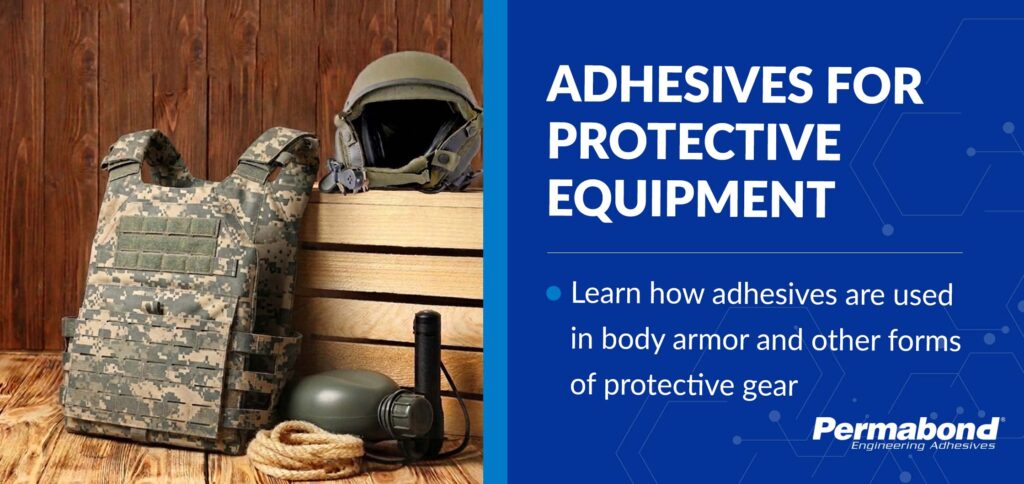
Personal protective equipment plays a critical role in ensuring the safety and security of defense personnel. Gear such as armor, helmets, and eye protection is critical for mission success, and must therefore be designed and manufactured to the highest standards. Adhesive technology plays a key role in this process and is constantly evolving to meet modern requirements.
Protective equipment has evolved significantly in recent years. From modern helmets and impact-resistant panels to advanced wearable protection systems, manufacturers are continually aiming to strike a balance between strength, comfort, durability, and keeping weight as low as possible. Material choice is of paramount importance in this industry.
Materials used in body armor & protective equipment
Material innovation is at the center of innovation in body armor and protective equipment. The primary consideration, of course, is that the gear does its job – protecting against bullets, shrapnel, fire and other hazards faced by defense personnel. However, it also needs to be practical – flexible to move with the wearer, breathable and as lightweight as possible for comfort, without compromising on performance.
Synthetic fibers like Kevlar® are the go-to material in both soft and hard armor. Its tightly-woven fibers allow for the dissipation of a bullet’s kinetic energy, with the same strength as steel at a fifth of the weight. In hard armor, a ceramic plate helps to dissipate the impact of a bullet, before a backing plate, usually made of ultra-high molecular weight polyethylene (UHMWPE), absorbs any residue.
Kevlar® and UHMWPE are also used in helmets for the same reason – they’re both lightweight, strong and incredibly impact-resistant.
Benefits of adhesives for body armor vs mechanical fasteners
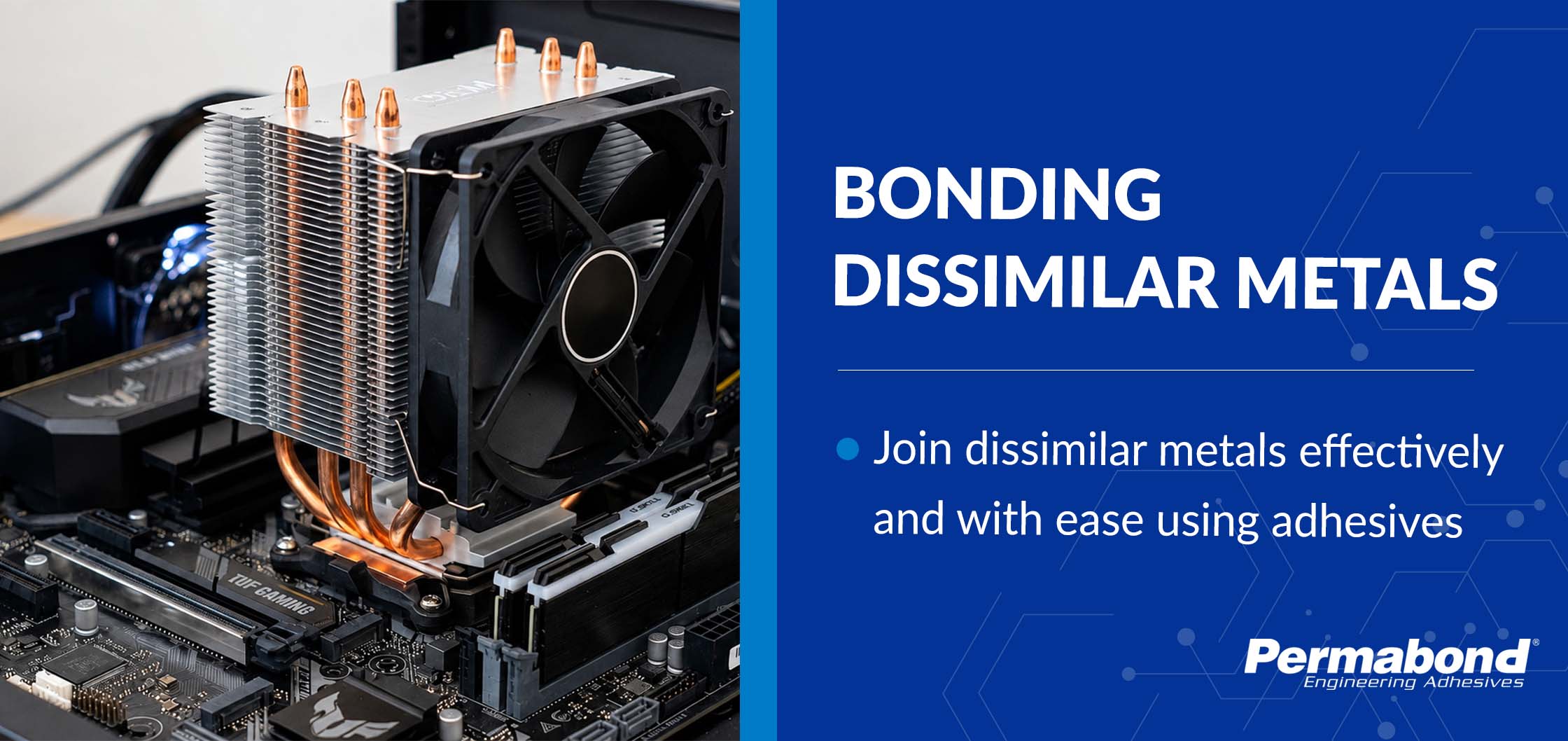
Adhesives used for body armor or other protective equipment offer a wide range of benefits compared to traditional methods of fastening. The first major benefit that they provide is the ability to bond dissimilar materials together. Helmets, for example, may incorporate thermoplastics, composite shells, foam energy absorbers, rubber components, visors, fabrics, and metallic fittings. Similarly, impact-resistant panels and protective enclosures often rely on combinations of aluminium, carbon fiber composites, polymers, and ceramics.
Mechanical fastening can create stress concentrations, add extra weight, or even damage sensitive substrates during assembly. Adhesives, on the other hand, distribute stress more evenly across bonded surfaces while enabling the joining of dissimilar materials without compromising structural integrity.
Structural epoxy and acrylic adhesives are particularly well suited to these demanding applications. Epoxies provide high strength, excellent environmental resistance, and strong adhesion to metals and composites. Acrylic adhesives offer rapid curing and excellent toughness, making them ideal for protective equipment subjected to repeated stress and impact.
By facilitating seamless bonding of various materials, adhesives give designers greater freedom to optimize performance while reducing overall assembly complexity.
Lightweighting – Without Sacrificing Performance
Keeping weight as low as possible is a major priority in protective equipment design. Whether for helmets, wearable protection systems, or impact-resistant housings, lower weight improves comfort, mobility, and long-term usability. However, while a low weight is important, it cannot come at the expense of durability or performance. This is where adhesives for body armor and protective equipment play a vital role.
Firstly, by replacing or greatly reducing the need for traditional mechanical fasteners, adhesives reduce component weight. Secondly, they allow manufacturers to use thinner materials and lightweight composite structures without introducing stress points associated with drilling or welding.
In helmet manufacturing, for example, adhesives may be used to bond outer shells to internal energy-absorbing liners, secure comfort padding, or attach additional functional components such as visors and communication systems. Adhesives’ ability to create strong, lightweight bonds contributes directly to wearer comfort while maintaining optimal performance.
Durability Under Repeated Stress
Body armor and protective equipment isn’t made to be worn while having coffee with a friend. It is designed with the toughest of environments in mind – extreme heat, cold, wind, fire, chemicals… Environmental stress is just a day in the life of equipment like this.
Protective equipment therefore needs to be durable, not only to be able to handle these stressors, but also because it needs to have a long service life. Militaries and law enforcement are on a budget, and don’t want to have to continually invest in new equipment because of failures or breakages. This makes durability of utmost importance.
Because impact and stress can come from anywhere, at any time, adhesives for body armor and protective equipment must remain durable under dynamic conditions while resisting cracking, delamination, or material fatigue.
Toughened adhesives are particularly valuable for body armor and protective equipment. Designed to absorb and dissipate stress, toughened epoxies and acrylics stay strong even when subjected to repeated flexing, impact, or thermal expansion differences between bonded substrates. In protective equipment applications, this toughness can help to preserve structural reliability over time, especially in systems where dissimilar substrates react differently to stress or temperature changes.
Modern structural adhesives are engineered to provide a balance of stiffness and flexibility, enabling movement without causing bond failure. This is especially important for wearable protective equipment where ergonomic performance and long-term durability must coexist.
Supporting Design Innovation
As protective equipment continues to evolve, designers are exploring more sophisticated designs and material combinations. Adhesives support this innovation by enabling cleaner assembly methods and more streamlined product designs. Unlike mechanical fastening, using adhesives ensures smooth external surfaces without unsightly protrusions or drilled holes. This improves appearance, reduces aerodynamic drag where relevant, and simplifies manufacturing processes.
Adhesives also support automation and scalable production. Fast-curing acrylics, for example, can improve assembly speed, while one-component epoxy systems may simplify dispensing and processing operations. Importantly, adhesive technologies enable engineers to focus on optimizing the entire assembly rather than designing around fastening constraints. This opens opportunities for improved ergonomics, integrated functionality, and enhanced user comfort.
The Future of Protective Equipment Assembly
The demand for lighter, stronger, and more comfortable protective equipment is growing, and will continue to drive material and manufacturing innovation. Adhesive technologies are becoming central to achieving these goals.
By enabling the reliable bonding of dissimilar materials, supporting lightweighting, and delivering durability under demanding conditions, adhesives for body armor and protective equipment help manufacturers create advanced protection systems that meet modern performance requirements. From toughened epoxies designed for high-stress environments to fast-curing acrylics that improve manufacturing efficiency, adhesive solutions continue to expand the possibilities for protective equipment design.
Please contact Permabond to find out more about our range of adhesives for body armor & protective equipment, or to discuss your application with us.
Let’s Discuss Your Project.
"*" indicates required fields
Products
Technical Support

Permabond will help you select the right adhesive for your application.