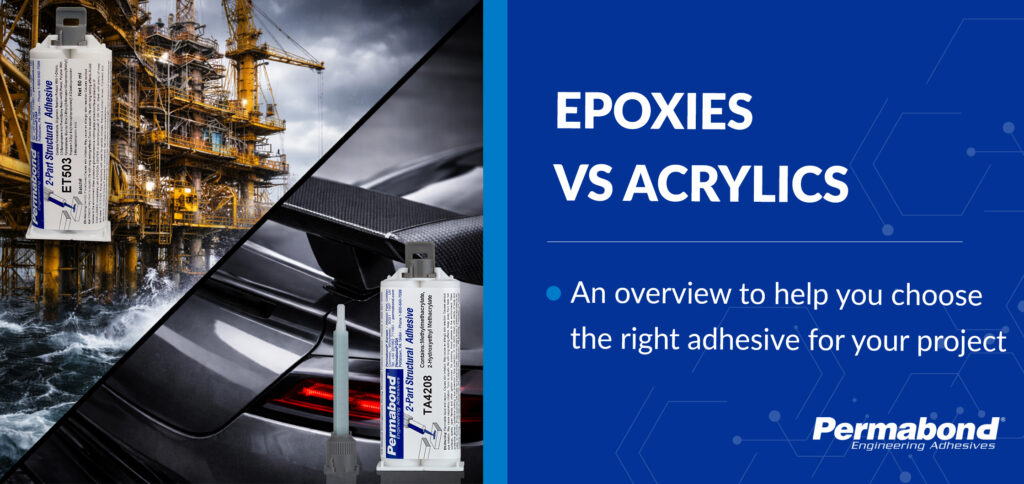
Epoxy adhesives and structural acrylics are two very commonly used adhesive products in industry. Both are very popular due to their high bond strength, yet there are key differences between them that need to be considered before choosing the right product for your application. In this article, we’ll cover what epoxies and structural acrylics are, similarities and differences between them, and how to know which one is right for your project.
Epoxy vs acrylic: their chemical nature
Both epoxies and structural acrylics are based on thermosetting polymer chemistry. This means that once cured, neither can be made liquid again through heating. They both achieve their high mechanical bond strength through crosslinking, a process whereby individual polymer chains in an adhesive chemically bond to form an interconnected network as the adhesive cures or sets. However, they differ in their monomer structure, curing mechanisms, and subsequent adhesive qualities.
Epoxy Adhesives: Rigid, High-Strength Networks
Epoxy adhesives consist of two parts: a resin and a hardener. When resin components react with a hardener, they form rigid molecular structures. During curing, these molecules form a highly cross-linked network.
Because of this tightly bonded structure, epoxies:
- Develop exceptional hardness and strength
- Offer strong resistance to heat, chemicals, and long-term loading
- Maintain dimensional stability with minimal shrinkage during cure
This rigidity makes epoxy adhesives ideal for applications where components must remain securely fixed under constant stress. Their stiffness means they are generally less able to absorb impact, vibration, or movement. However, they can be formulated to do so if required.
Structural Acrylic Adhesives: Tough, Flexible Networks
Structural acrylic adhesives are made from fast-reacting liquid components that rapidly form long molecular chains, which then connect into a solid network. This network tends to be more flexible and less rigid than that of epoxies. Structural acrylics are either based on standard acrylic acrylates, or methacrylate monomers such as methyl methacrylate (MMA). Acrylic adhesives tend to:
- Absorb energy instead of cracking
- Perform well under impact, vibration, and cyclic loading
- Cure significantly faster than standard epoxies
- Bond reliably even to imperfect or lightly contaminated surfaces
Their molecular structure gives structural acrylics a reputation for toughness and ease of use, making them well suited for high-speed manufacturing and demanding assembly environments.
The different types of structural acrylics
There are several different types of structural acrylic adhesives, and they each have their own benefits and drawbacks. In addition to the aforementioned MMAs, there are three major types of acrylic adhesives:
- Surface-activated acrylics
- One-part acrylics
- Two-part acrylics
Surface-activated acrylics
These require the use of a initiator or accelerator before bonding. Products such as Permabond Initiator 41M or Permabond A905 can be used for this purpose. These leave an active layer on the surface of the substrate which then reacts with the adhesive resin to trigger cure. Advantages of surface-activated acrylics include no need for any mixing and very fast strength development when used alongside an initiator.
One-part acrylics
These come ready to use (no mixing required) with cure often initiated by heat or anaerobically (in the presence of metal / absence of oxygen). Their cure speed & strength development can be sped up by using an initiator, as with surface-activated acrylics. They are convenient to use and offer good bond strength on many substrates. Products such as Permabond TA437 fall into this category, offering excellent heat resistance and ideal for motor magnet bonding.
Two-part pre-mix acrylics
These are supplied in cartridges where the two parts get mixed together during dispensing via a static mixing nozzle. This means no manual mixing is required as the product comes out of the nozzle ready to use. They offer high bond strength and mechanical performance and can often tolerate higher temperatures better than other acrylics. However, there is a risk of product wastage when using static mixing nozzles due to the product drying out inside the nozzle.
Because structural acrylics are so reactive and less reliant on a stoichiometric mix ratio, they can be used with shorter mixing nozzles than an epoxy adhesive. Some grades can also be applied “bead on bead” such as with Permabond TA440, where the A and B side can be applied one on top of the other or on opposite parts which can then be sandwiched together.
MMA acrylics
MMAs are high strength, two-part structural acrylic adhesives that cure quickly at room temperature. They offer high impact and vibration resistance as well as consistent overall bond strength. They excel at bonding a wide variety of substrates including dissimilar materials. However, they are flammable and therefore considered DG for shipping in large quantities, and have limited temperature resistance.

MMAs vs non-MMAs – pros and cons
Some benefits of MMAs over non-MMA acrylics include:
- Consistent high bond strength
- Excellent vibration, impact and stress resistance
- Tack-free curing
- Provide environmental protection to the joint because you can bond in a fillet
- Some Permabond MMAs such as TA4208 contain adhesion promotors that allow for bonding through oily surfaces or oxide layers without surface treatment
Some benefits of non-MMA acrylics include:
- Safer to ship and handle – MMAs are flammable and labelled DG for shipping
- Easier to store – MMAs need to be kept in the fridge, whereas other types of acrylics can be stored at room temperature
- Non-mix structural acrylics lead to less wastage
- Easier to spread over a large bond area
- Low odour options available
- Can withstand higher temperatures – MMAs generally max out at 120°C (248°F)
- Some cure and reach good strength much more quickly than MMAs – think surface-activated acrylics
Not all epoxies are the same!
Just as not all structural acrylics are the same, neither are epoxies! Epoxy adhesives come in two different types: 1-part and 2-part epoxies. Both types achieve very high strength on a variety of substrates, but there are key differences between them which affect adhesive choice. One-part epoxies are sold with the resin and hardener pre-mixed, hence ‘one-part.’ Two-part epoxies, on the other hand, are sold as part A and part B, and need to be mixed at the correct ratio before bonding. Many Permabond 2-part epoxies are sold in cartridges with a mixing nozzle, meaning the adhesive gets mixed in the nozzle and thus comes out ready to use. When buying in bulk, however, you will need to manually mix parts A and B together first – this creates an additional step in the bonding process.
Another key consideration is that 1-part epoxies require heat to cure. This is often done via induction or in an oven. Without heat, single-part epoxies will remain liquid and won’t cure. This is important to bear in mind, because with 1-part epoxies your production process and parts to be bonded must allow for a heat cure. In terms of storage, 1-part epoxies should be kept in the fridge, whereas 2-part epoxies can be stored at room temperature.
You can read more about 1-part and 2-part epoxies in this feature article.
Key differences between epoxies and acrylics
So, we know that both epoxies and structural acrylics are strong, rugged adhesives that achieve high bond strength through crosslinking. But apart from this, how do you know which one is best to choose for your project? Below, we’ll discuss key differences between these two types of adhesives in several important areas:
- Strength development & performance
- Substrate compatibility
- Durability (to temperature, chemical, vibration exposure)
- Shipping & storage
- Ability to customise for individual project needs
- Pricing
Let’s get started!
Epoxy vs acrylic: strength development & performance
There are big differences in how quickly epoxy adhesives and structural acrylics gain strength. 1-part epoxies are actually very quick at developing strength because of their heat cure. Full strength can be reached in under an hour in some cases, depending on the adhesive and heating method. 2-part epoxies, on the other hand, cure at room temperature but can be sped up by using heat. With a 2-part epoxy, the warmer the curing environment, the faster it will cure and vice versa. A standard 2-part epoxy cured at room temperature (23°C/73°F) takes between 24-48 hours to reach full strength. More expensive mercaptan-based epoxy systems, however, cure much faster, achieving full strength at room temperature in 3-4 hours.
Structural acrylic adhesives achieve high strength rapidly at room temperature, depending on the technology. At 23°C (73°F), an MMA is likely to achieve good, workable strength in as little as 2-3 hours. A surface-activated acrylic, when used with an initiator or activator, can achieve working strength in as little as 5 minutes!
In terms of performance, epoxies tend to be more rigid than acrylics. They offer high shear and compression strength, but apart from some toughened grades, fairly low peel strength. Acrylic adhesives, on the other hand, have high shear and peel strength as well as good impact and vibration resistance. The table below gives some shear and peel strength values of each on steel and aluminium.
| Standard Epoxy | Toughened Epoxy | MMA Acrylic | |
| Lap Shear Strength (steel) | 12-15 MPa
(1740-2175 psi) |
28-34 MPa
(4061-4931 psi) |
27-31 MPa
(3916-4496 psi) |
| Peel Strength
(aluminium) |
20 N/25mm | 200 N/25mm | 150 N/25mm |
Winner: Structural acrylics
Epoxy vs acrylic: substrate compatibility
Epoxies are excellent on metals, composites, and ceramics, but have limited performance on plastics. They can’t bond through oily or otherwise contaminated surfaces, however they can be painted or powder coated after curing.
Structural acrylics bond well to metals, composites, ceramics, and glass. In addition, many offer good performance on plastics, even on challenging ones like polyolefins and nylon. Certain structural acrylics like Permabond TA4208 Black are able to bond through oily surfaces and oxide layers, like those found on aluminium.
Winner: Structural acrylics
Epoxy vs acrylic: durability
Epoxies have excellent environmental resistance, making them highly suited to outdoor applications. Products like Permabond ET503, a two-part epoxy, are ideal for outdoor applications and will cure in temperatures as low as 5°C (41°F). Epoxies also have good resistance to water (even saltwater) and humidity, and also withstand polar solvents well. However, when it comes to temperature, standard grade two-part epoxies tend not to withstand extreme heat or cold, normally requiring a secondary heat cure to do this. One-part epoxies such as ES5516 are better here, though. Since they can be quite rigid and stiff once cured, compared to structural acrylics epoxies are less capable of dealing with impact and vibration.
Structural acrylic adhesives also provide excellent environmental resistance, but perhaps not as high as that of an epoxy. They also withstand stress, impact, and vibration well, and high temperature grades are available.
Winner: Both
Epoxy vs acrylic: shipping & storage
Epoxies are considered hazardous goods (but not dangerous) for shipping. 1-part epoxies should ideally be kept in the fridge, as they can begin to thicken when stored at room temperature. 2-part epoxies can be stored at room temperature, and have a 12 month shelf life both in cartridges and in bulk.
MMAs are considered dangerous goods (DG) for shipping due to their flammable nature. This can make them more difficult and expensive to procure, although small quantities are usually fine. They should be kept refrigerated, and their shelf life can be somewhat limited when bought in bulk. Non-MMA acrylics, on the other hand, don’t have these limitations since they aren’t flammable and can be kept at room temperature.
Winner: Epoxies
Epoxy vs acrylic: ability to tweak/customise
Epoxy adhesives are quite customisable. It’s fairly easy to alter their rheology (thickness), curing speed, colour, temperature resistance and toughness. They can also be made food compliant to meet FDA and EU restrictions. With generally stable formulations, you normally don’t need to conduct long-term storage tests before using a customised epoxy.
Certain structural acrylics, on the other hand, are difficult to customise, because doing so can lead to instability in the adhesive. This is mainly a concern for MMA-based structural acrylics. It’s not impossible to customise these, but takes significantly longer than with an epoxy. No structural acrylic can be made food compliant because they contain raw materials on the list of forbidden substances for food contact as stated by the FDA and EU.
Winner: Epoxies
Epoxy vs acrylic: pricing
MMA structural acrylics tend to be significantly more expensive than any kind of epoxy. Non-MMA grades are similarly priced to mercaptan or toughened epoxies, and all of these are much more expensive than standard epoxy grades.
Winner: Epoxies
To summarise, epoxies:
- Offer high bond strength
- Can be quite rigid once cured
- Are good on metals, ceramics and composites but not on plastics
- Have excellent environmental resistance
- Can have good heat resistance
- Can be easily customised
- Are easier to ship and store
- Can be made food grade
While structural acrylics:
- Offer high bond strength
- Bond well to metals, ceramics, composites and plastics
- Have good durability
- Can be more complex to ship (MMAs)
- Are more difficult to customise (MMAs)
- Tend to be more expensive
Epoxy vs acrylic: how to choose between them & example use cases
We’ll now focus on some specific needs that many manufacturers have, and which type of adhesive we’d recommend in each case.
- If you need an adhesive that is strong and cures quickly: Choose a structural acrylic or a mercaptan-based epoxy.
- If you have a large bond area: Both can work well, but make sure to avoid an MMA in this case as they generally aren’t as easily spread over a large area.
- If your application involves oily/greasy surfaces or oxide layers: Choose an acrylic such as Permabond TA4208.
- If you need a long pot life/open time: An standard epoxy or a standard acrylic are both good options. Avoid MMA-based acrylics here, as they tend to have a much shorter open time.
- If your application is exposed to severe environmental conditions: An epoxy is likely to be better here. Consider a toughened product such as Permabond ET503.
- If your application involves plastics such as polyethylene, polypropylene or nylon: Use an acrylic. The Permabond TA46XX range of structural acrylics bonds challenging plastics without needing any surface treatment. Permabond TA4550 bonds many types of nylon very effectively.
Further considerations
- If your application requires heat resistance: Both are suitable. Permabond ES5516 is a one-part epoxy that is ideal for bonding class H motor magnets in electric vehicles. Permabond TA437 (structural acrylic) is also ideal for magnet bonding and withstands up to 200°C/392°F.
- If you need a food-safe adhesive: Epoxy all the way. Structural acrylics cannot be made food-safe to FDA or EU standards. Permabond ET5164 is a two-part epoxy that meets FDA and EU regulations for food contact.
- If you’d like a custom product: An epoxy is generally easier to customise than a structural acrylic. MMAs in particular are hard to customise.
- For easier shipping: On the whole, epoxies are easier. MMAs, which are common and popular acrylics, are deemed DG due to their flammability.
- If pricing is an issue: An epoxy is likely to be cheaper, especially when bought in bulk.
Final Thoughts
Epoxies and structural acrylics are both strong, durable adhesives that offer a range of benefits to manufacturers. Their use in industry is widespread and both will continue to be popular as new product innovations are brought in. Here we have highlighted when and why you may wish to choose either an epoxy or a structural acrylic for your project, but if you’d like further help or to discuss your application with us, please contact our technical team.

Permabond will help you select the right adhesive for your application.

Permabond products are sold through distributors worldwide.

Permabond is an ISO QMS Certified company.