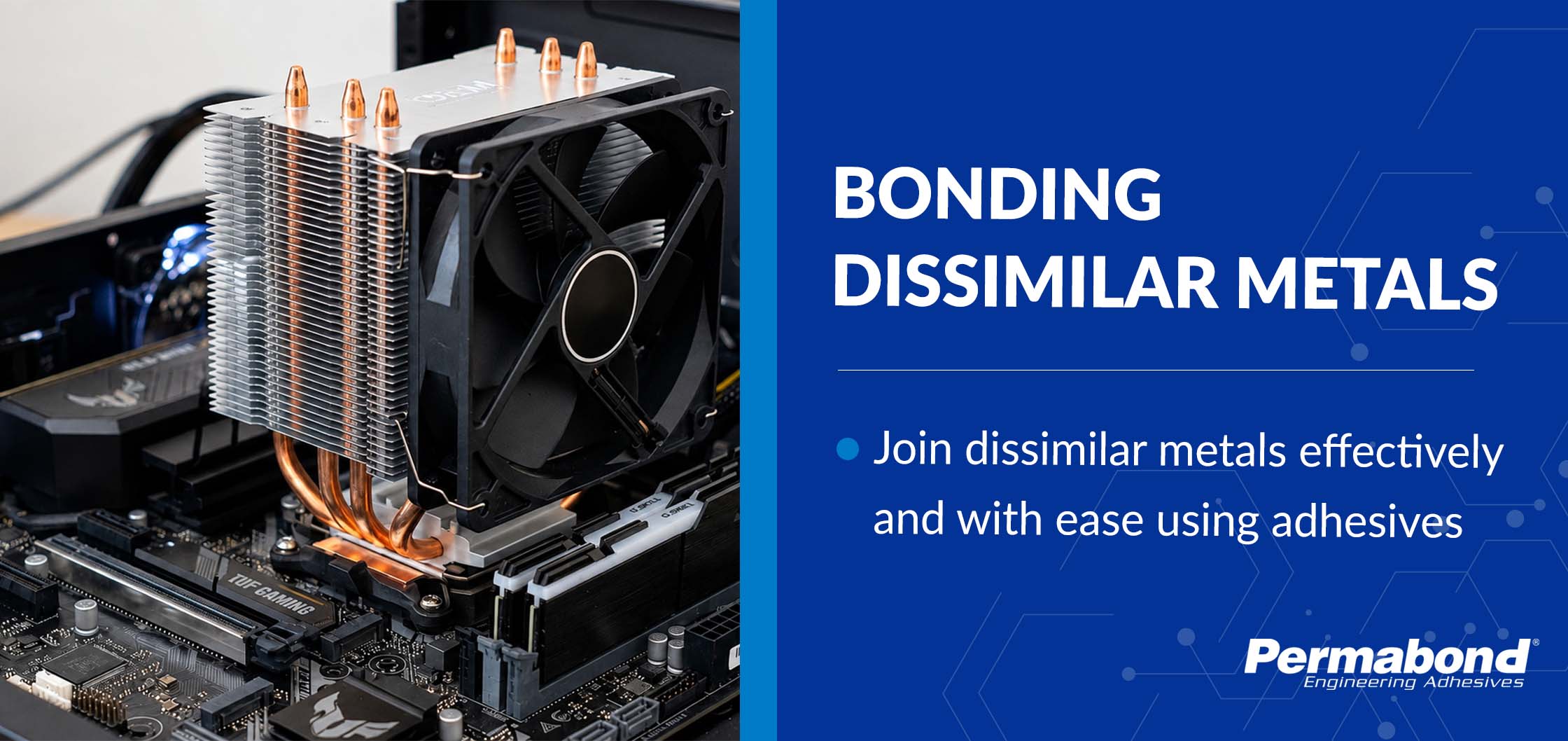
We recently published comprehensive articles on bonding a variety of metals, including aluminium, copper and stainless steel. Joining metals with adhesives follows a broadly similar pattern: clean and properly prepare the surface, ideally use a primer, and then bond. Bonding different metals together, such as aluminium to copper, follows similar steps, but adds another layer of challenge compared to bonding two like metal parts. In this article we’ll explore the factors you need to consider when bonding dissimilar metals and how to choose the right adhesive for your application.
Why join dissimilar metals?
Modern products rarely consist of only one material. In the case of metals, different metals bring different things to the table – some bring great electrical conductivity, some bring excellent resistance to corrosion and rust, some are lightweight while others are easier to machine & shape. A major benefit of incorporating adhesives into your product design is that you gain much greater freedom and flexibility in your choice of materials – so you can freely choose the best metals that work for what your product is meant to achieve.
Where are dissimilar metals joined? Real-life applications
There are many real-world applications where dissimilar metals come into contact with each other. Some examples include:
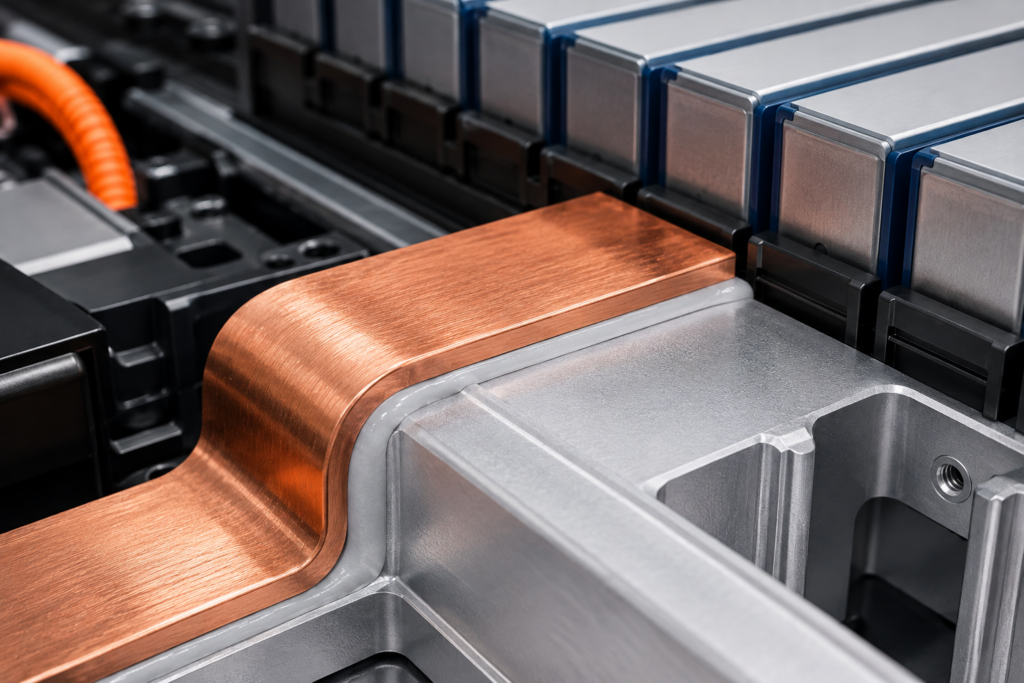
- Electric vehicle batteries – in EV batteries, copper current collectors are connected to aluminium tabs or busbars. Copper’s superior electrical conductivity combines with aluminium’s lightweight and cost-effective properties.
- Car frames – another automotive application is bonding aluminium panels to high strength steel frames. The lightweight nature of the aluminium improves fuel efficiency, while the strength and durability of the steel increases crash safety.
- Aircraft fuselages – titanium skin sections are bonded or fastened to aluminium substructures in high-performance aircraft for optimal stress and temperature resistance.
- Plumbing – connecting copper water pipes to steel or brass fittings.
In all of the examples above, dissimilar metals are chosen because each one complements the other and enhances the overall performance of the end product.
Challenges when bonding dissimilar metals
Just like plastics, different metals have differing characteristics. Unlike when bonding like metal parts together, when bonding dissimilar metals certain factors arise that need to be considered when bonding with adhesives. The most important of these are:
Thermal expansion mismatch
Probably the biggest issue to consider. Every material has its own coefficient of thermal expansion, or CTE for short. This number describes how much a material will expand when heated, and contract when cooled. A higher CTE value indicates greater expansion and contraction with heating and cooling, and vice versa. When bonding like metals together, say steel to steel, CTE doesn’t matter so much as the rate of expansion and contraction between parts is the same. With dissimilar metals, however, one can expand and contract more with temperature changes than the other, leading to increased stress on the joint area. For example, titanium has a CTE of roughly 8.6, while aluminium’s value is around 23, meaning aluminium expands around 3 times as much as titanium with heat. Too great a mismatch with the wrong adhesive can easily lead to bond failure over time.
| Metal | CTE (µm/m·°C) | Typical range |
| Aluminium | 23 | 22–24 |
| Copper | 17 | 16.5–17 |
| Brass | 19 | 18–20 |
| Carbon steel | 12 | 11–12 |
| Stainless steel | 17 | 16–17.5* |
| Titanium | 8.6 | 8–9 |
| Tungsten | 4.5 | 4.3–4.6 |
| Bronze | 18 | 17–18 |
| Zinc | 30 | 29–31 |
Risk of galvanic corrosion
Galvanic corrosion (also known as dissimilar metal corrosion) is a process where one metal corrodes when in electrical contact with another, in the presence of an electrolyte. It requires a conductive liquid to occur, as the liquid serves as the electrolyte. The less reactive metal of the two acts as an anode, drawing electrons, while the more reactive one gives off electrons and corrodes. Let’s imagine we have an application where steel and aluminium are in direct contact with each other, where moisture has gotten into the joint. In this case, being the more active metal, the aluminium would gradually begin to corrode – this, despite aluminium being known for its corrosion resistance!
Joint design is more important
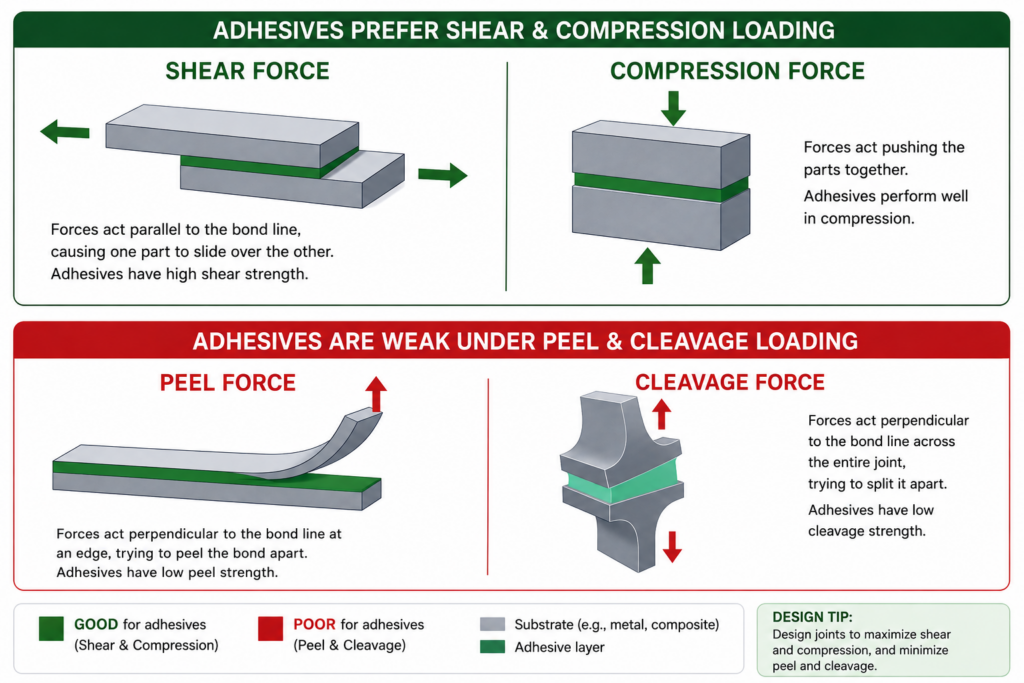
Considering the differences in CTE mentioned above, when designing a dissimilar metal joint it’s particularly important to maximize shear and/or compression forces and avoid peel or cleavage joints. This minimizes stress and pressure on the adhesive joint after curing.
How to solve these challenges
For a thermal expansion mismatch, choose an adhesive that is toughened. Many epoxies fall into this category. A toughened epoxy adhesive with good shear and/or peel strength will have the flexibility and stress resistance needed to absorb the impact of differential thermal expansion and contraction. If high strength isn’t so much of a priority, using a modified epoxy adhesive also provides excellent flexibility to handle CTE mismatches – look for Permabond adhesives named ‘MT-‘. Another thing that helps here is using a thicker glue line between the dissimilar metals, as this adds more ‘bulk’ to accommodate stress movement.
To prevent galvanic corrosion, it’s essential to have a complete seal of the bond area. This is especially important if the application is likely to be subjected to water or moisture – seawater is especially problematic due to its high salt (electrolyte) content. Thankfully, simply by using adhesives, this becomes much easier to achieve. Mechanical fasteners often don’t provide a 100% seal, whereas the right adhesive, applied properly, almost always does. A thicker bond line is again helpful here, as it can help to reduce electrical conductivity between the two metals and prevents fretting, a process where molecules on the two metal surfaces rub against each other, eventually leading to corrosion.
In terms of joint design, when using adhesives, you ideally want to design joints that will be in shear or compression and avoid peel or cleavage joints. Doing so helps to more evenly distribute stress across the bond area. Make sure to allow space for an optimal adhesive gap, as this will help to prevent stress caused by CTE mismatch.
But can’t I just weld instead?
You may be wondering whether, instead of having to think about all this thermal expansion and galvanic corrosion business, you couldn’t just weld two dissimilar metals together instead?
The answer is yes, but often with difficulty. Instead of thinking about CTE values, with welding you have deeper metallurgical concerns with melting points of various metals to contend with. When wanting to weld aluminium to steel, for example, you have the issue that aluminium’s melting point (~660°C/1220°F) is about half that of steel (~1350°C/2500°F). So, before you got to the point that you could weld the steel, the aluminium would have already melted away! Welding more similar metals like carbon steel to stainless steel is easier, but any metals with vastly different melting points will be difficult to weld.
More advanced welding techniques like laser welding can be used for this purpose, but when you can just use a humble structural adhesive instead and get similar results, we’re not really sure why you’d want to!
The best adhesives for bonding dissimilar metals
With that said, let’s discuss the best adhesives for bonding dissimilar metals. Generally speaking, the right choice here depends on the metals you’re bonding, the environmental and temperature conditions, joint type and strength requirements. Below we list some of the most commonly chosen adhesives for bonding dissimilar metals.
Epoxies
If you’re looking for the ultimate in toughness and strength, an epoxy adhesive is a very strong choice. Epoxies offer high shear and peel strength values, making them highly suitable for handling differences in thermal expansion and contraction between metals. Consider Permabond ET5428 and its sister product ET5429 for dissimilar metal applications where high strength is important and differential CTE plays a significant role. If you don’t mind a slower cure or can heat cure, Permabond ET5441 was developed for bonding dissimilar substrates and has excellent temperature resistance. In addition, it handles thermal cycling very well, minimizing stress on the joint area.
Single-part heat cure epoxies provide the ultimate in structural strength when bonding dissimilar metals, with similar strength to welding. If strength is your priority and you’re able to heat cure, we’d strongly recommend considering a single-part epoxy for your application. Grades like Permabond ES550 and ES558 have outstanding shear strength on metals.
Anaerobic Adhesives
Anaerobic adhesives can be a very good choice for bonding dissimilar metals. This is especially true if one of the metals has a more active surface like copper or brass. Curing in the presence of metal and the absence of oxygen, these adhesives achieve a quick cure in a tight gap. They’re well suited to threaded and cylindrical joints in particular, where the gap is very small. Normally only suitable for joining like materials, anaerobic adhesives can be used for slip, interference and shrink fit joining techniques on dissimilar metals.
Permabond F201 has core shell rubber toughening, making it highly suitable for accommodating stress and impact. Its sister product, Permabond F201HV, offers a higher viscosity with similar benefits.
Structural Acrylic Adhesives
Structural acrylic adhesives are another strong contender for bonding dissimilar metals. Apart from offering high strength on many metals, we have formulated several structural acrylic adhesives with a special surface adhesion technology. This technology allows the adhesive to bond unprepared metal surfaces, for example through oily surfaces or oxide layers. These are therefore of particular interest to those who can’t perform extensive surface preparation or wish to optimize efficiency.
Permabond TA4207, TA4208 and TA4230 – which also offers fire retardancy – all feature this surface adhesion technology. Permabond TA4550 is another strong candidate for bonding dissimilar metals, offering the rarity of both high strength and high flexibility. This structural acrylic adhesive, originally developed for bonding nylon, offers outstanding strength on many metals.
Cyanoacrylates
Cyanoacrylates (also known as superglues) are some of the fastest-curing adhesives around. They cure by reacting with moisture in the air and on the surfaces of materials. Because they cure so quickly, they tend to be better for bonding smaller parts. They aren’t so well suited for handling big differences in thermal expansion and contraction, but are ideal when you need high strength on small surface areas.
Consider Permabond 751 – a new, flexible adhesive ideal for bonding medical devices – as well as Permabond 737 and 910 for bonding dissimilar metals.
The Importance of Surface Preparation
When bonding metals, the right surface preparation is really important – and even more so when bonding dissimilar metals. Mismatches in thermal expansion and contraction can put additional stress on an adhesive bond compared to bonding like metals, so ensuring that your surfaces are in an ideal state for bonding is essential here.
Unless you’re opting for one of our surface-activated structural acrylic adhesives (like TA4207 or TA4208) mentioned above, follow these steps to prepare your metals for bonding:
- Clean & Degrease. Wipe your metals with acetone, isopropanol or Permabond Cleaner A to remove dust, oils, fingerprints and release agents. We recommend you do this even with using a surface-activated structural acrylic for best results.
- Abrade. Abrasion using sandpaper or grit paper (or alternatively grit blasting) helps to remove the oxide layer present on many metals. It also helps to ‘scratch up’ the surface and provide more grip for the adhesive. Working Permabond 2K Primer into the surface after abrading helps ensure the metal surface doesn’t start to reoxidize. It also acts as an adhesion promoter and ensures a longer-lasting bond.
- Clean again. After abrading, clean the surface again to remove any debris.
- Bond. Your metals are now good to bond. If you’ve used 2K Primer, you’re in no rush here – the metal surfaces won’t reoxidize after abrasion. If you haven’t used a primer, the sooner you bond the better, otherwise the metals will reoxidize and you’ll have to repeat the abrasion process again.
Frequently Asked Questions (FAQs) on bonding dissimilar metals
-
What is the best adhesive for bonding dissimilar metals?
There is no single best adhesive for every metal combination. Structural epoxies and acrylics are common choices, while cyanoacrylates and anaerobic adhesives can be suitable for particular joint designs and applications. Temperature, joint size, required flexibility and the metals being bonded should all be considered.
-
Can you bond aluminium to steel with adhesives?
Yes. Adhesives can successfully bond aluminium to steel and can offer advantages over mechanical fastening or welding. Particular consideration should be given to differential thermal expansion values and avoiding galvanic corrosion when designing the joint.
-
How do you prevent galvanic corrosion when joining dissimilar metals?
Galvanic corrosion requires electrical contact between dissimilar metals and an electrolyte, such as water. An adhesive layer can electrically isolate the two metals while also helping to seal the joint against moisture, reducing the risk of galvanic corrosion.
-
Does thermal expansion affect adhesive bonds between different metals?
Yes. Metals have different coefficients of thermal expansion (CTE), meaning they expand and contract by different amounts as temperature changes. Toughened or more flexible adhesives can help accommodate this differential movement and reduce stresses within the joint.
-
Do dissimilar metals need surface preparation before adhesive bonding?
Usually, yes. Removing oils, contamination and weak surface layers generally improves bond reliability. The optimum preparation depends on the metals and adhesive involved; some structural acrylic adhesives (like Permabond TA4207, TA4208 and TA4230) are more tolerant of minimally prepared or slightly contaminated surfaces than many epoxies.
-
How soon after abrading do I need to bond metal parts?
This depends on the metal. For those highly prone to oxidation like aluminium, the parts should be bonded as soon as possible after abrasion to prevent reoxidation. Alternatively, if you use Permabond 2K Primer during the abrasion process, you have a lot more time!
-
Is adhesive bonding better than welding or fastening dissimilar metals?
It can be. Adhesives distribute stress over a larger area, avoid welding heat, can join metals that are difficult to weld together (like steel to aluminium) and can electrically isolate dissimilar metals. Adhesives can provide similar strength to welding and fasteners and are better for preventing galvanic corrosion between metals.
If you have any questions about bonding dissimilar metals or to discuss your application, please contact us.

Permabond hilft Ihnen, den richtigen Klebstoff für Ihre Anwendung auszuwählen.

Produkte von Permabond sind über Vertriebshändler in allen Teilen der Welt zu beziehen. Hier können Sie unsere Vertriebshändler finden.

Permabond ist ein nach ISO QMS zertifiziertes Unternehmen.