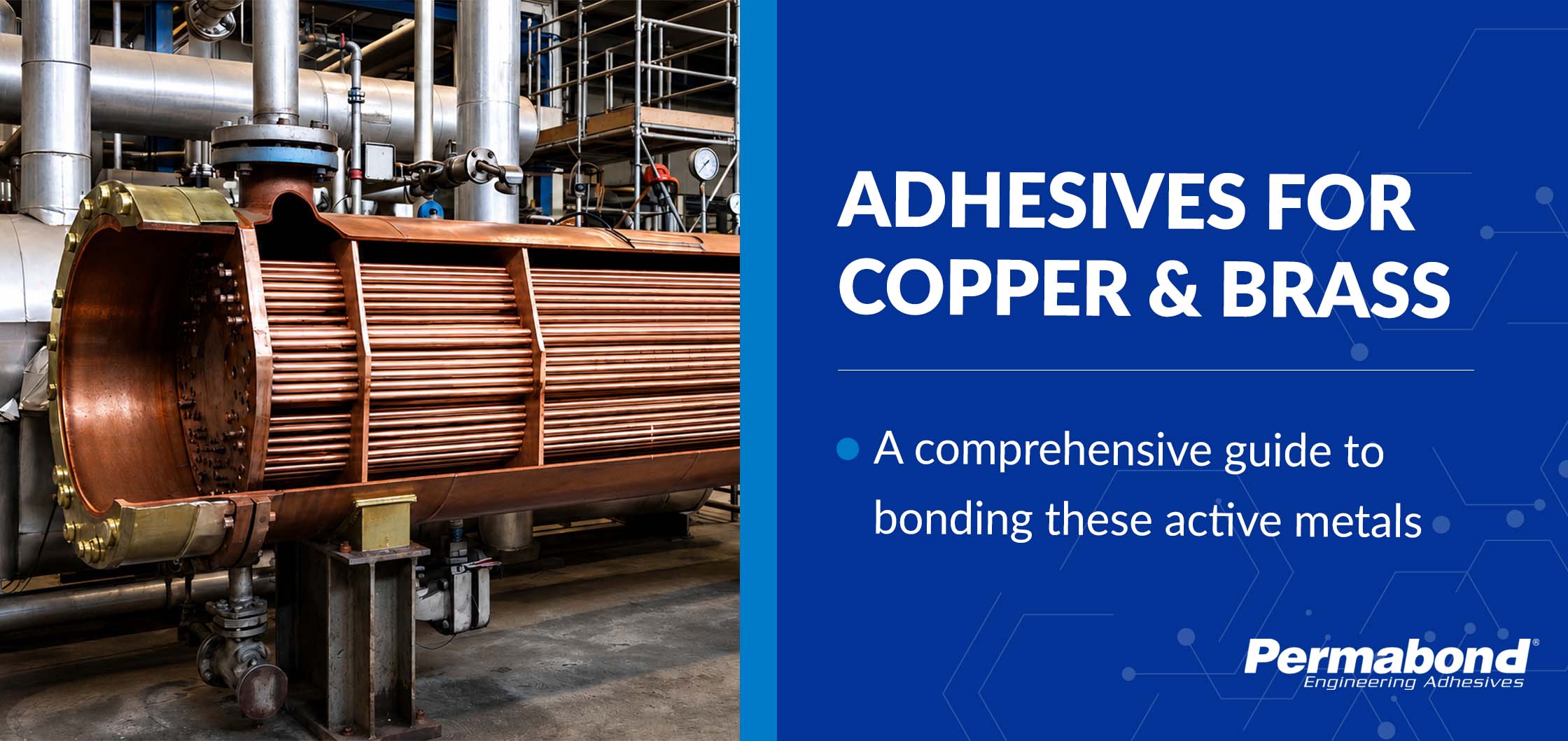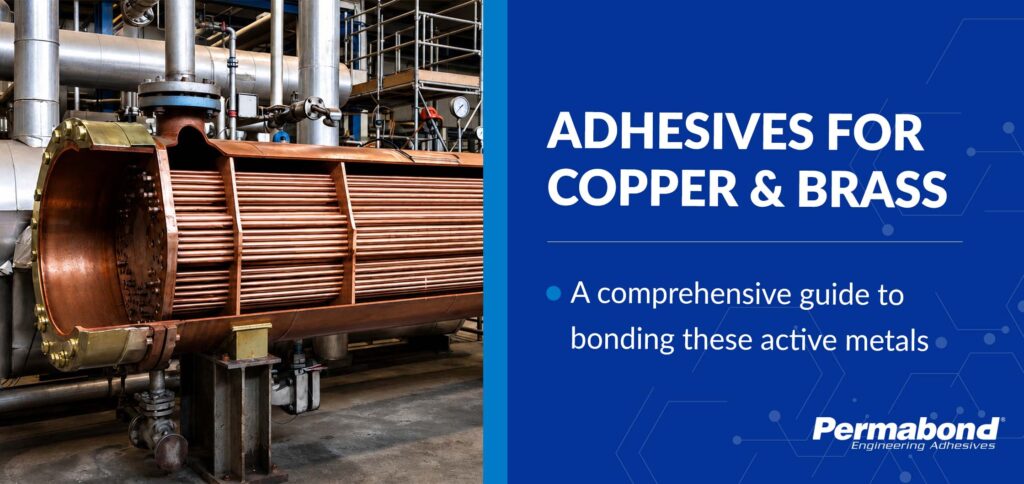
Copper and brass remain highly popular metals used in engineering. Both these metals are strong and durable, machinable and highly resistant to corrosion. In this article we’ll discuss why copper and brass are so well-loved across industry, how best to bond them (including correct surface preparation) and the best adhesives for copper and brass.
Why engineers choose copper
- Exceptional electrical conductivity. Copper is the second-most conductive metal in the world, with only silver being more conductive. And with copper being significantly cheaper than silver, it’s the natural choice for power distribution, electrical wiring and heat exchangers.
- High malleability. Pure copper is ductile and highly malleable. It can easily be bent, stretched or drawn without breaking.
- Naturally resistant to corrosion. Copper doesn’t rust. It develops a green patina when exposed to oxygen and moisture, which protects the metal from degradation.

Why engineers choose brass
- Excellent machinability. The addition of zinc to copper increases hardness and stiffness, making brass very easy to cut, drill and shape.
- High mechanical strength. Brass offers high tensile strength and rigidity, allowing it to withstand repeated mechanical motions.
- Low friction & wear. Brass has a low coefficient of friction, which makes it well suited to applications that involve metal parts coming together – e.g gears, bearings and valve fittings.
Below are some typical copper and brass industrial applications:
- Plumbing and pipe fittings
- Heat exchangers
- Electrical components
- HVAC systems
- Decorative metalwork
- Marine hardware
The differences between copper and brass
You may have noticed that copper and brass can look quite similar. This is because, in many ways, they are! Copper is a pure, natural metal, whereas brass is an alloy (mixture) of copper and zinc. There are various grades of brass with different ratios of copper to zinc, but there is always more copper than zinc in the mixture. This is why copper and brass often look alike.
While broadly similar, copper has superior flexibility and electrical conductivity compared to brass, whereas brass is stronger and more ductile than copper. Both metals are corrosion resistant and highly machinable.
Grades of brass
Brass comes in different grades, i.e. mix ratios. Some of the most common ones are listed below.
- Cartridge brass (C26000 / CW505L). A 70/30 copper to zinc mix, so-called for its use in gun cartridge cases. Apart from ammunition cases, cartridge brass is used in heat exchangers, electrical connectors and decorative components.
- Free-cutting brass (C36000 / CW614N). A very common engineering brass. This grade consists of roughly 62% copper, 35% zinc and 3% lead. The addition of lead further improves the already high machinability of the metal. Often used in valves, pipe fittings and other threaded connectors as well as hydraulic components.
- Naval brass (C46400 / CW712R). Roughly 60% copper, 39% zinc and 1% tin. The tin improves its resistance to seawater, hence the name. Often used in marine-based applications.
Surface preparation of copper and brass
It’s tempting to think that choosing the right adhesive for copper or brass alone is enough to get a good bond on these metals. However, as with aluminium, the right surface preparation is key to ensuring a strong copper or brass bond. Both copper and brass react with oxygen to form an oxide layer (patina), though this is likely to be more visually obvious on copper. In any case, this layer needs to be removed to ensure a good quality, durable bond on either metal. See the steps below for how to prepare your copper or brass for bonding.
Remove contaminants.
Use a solvent to clean the surface of the metal and remove oil, grease, dust, release agents and other contaminants. Isopropanol, acetone or Permabond Cleaner A are all suitable for this purpose. Note: this step alone is NOT enough to remove the oxide layer.
Remove the oxide layer.
Now that your surface is clean, it’s time to remove the oxide layer on your copper or brass. The best way to do this is via light abrasion or grit blasting. To make this process more effective, consider using a surface primer. You can apply Permabond 2K Primer to the metal surface before abrading, and then work it in with gritpaper. Not only will this abrade the surface and remove the oxide layer, but the worked in 2K Primer will prevent re-oxidization of the surface afterwards, giving you far more time to bond! See the video below on how to use Permabond 2K Primer.
Clean again.
After abrading or grit blasting, clean the surface again with solvent to remove any debris.
Bond.
Your copper or brass is now ready for bonding. Bear in mind that a new oxide layer will start to form on the surface of the metal after this process, so the sooner you can bond, the better your results will be. Unless of course you used Permabond 2K Primer – in which case you can take your time!
Adhesives for copper and brass
There is a variety of adhesives that bond copper and brass. The type of adhesive you choose depends on the nature of your application – for example, will it be subjected to impact and vibration, temperature fluctuations or adverse weather conditions? Is it a threaded application, or does it involve bonding large panels together? Bearing questions like these in mind will help you when choosing the right adhesive for your project.
With this said, not all types of glue are good on brass and copper. Below we will highlight some of the best adhesive chemistries for these metals.
Anaerobic adhesives for copper and brass
Anaerobic adhesives cure (harden) in the presence of metal and the absence of oxygen. They are very popular in plumbing, pipework, and general maintenance and repair jobs. They’re particularly well suited to bonding copper and brass, since both of these are highly active metals – not in the traditional sense of freely oxidizing and corroding, but in that they freely ‘give out’ metal ions to kickstart the curing process of an anaerobic adhesive. Metals which are heavily alloyed, plated or oxidized – think aluminium, stainless steel or titanium – don’t give ions at anywhere near the same rate and subsequently take much longer to bond with anaerobic adhesives.
Another reason that anaerobics make such good adhesives for copper and brass is their suitability for use in pipe applications. Copper is a very popular metal in domestic and commercial pipework, and anaerobic adhesives and sealants are ideal for sealing threaded pipe joints. A variety of grades are available offering various strengths and approvals to suit your needs.
Permabond F200, and its higher viscosity, hydrogen-ready cousin Permabond F201HV, are both excellent anaerobic adhesives for copper and brass. Both are toughened, with high peel strength and impact resistance. F200 and F201 have WRAS and KTW-BWGL approvals for drinking water, whereas F201HV is KIWA-approved for contact with hydrogen. These adhesives are brown, making them a nice color match for copper or brass. The rubber toughened matrix makes for a high strength, robust bond with great resistance to vibration, thermal shock and expansion stresses.
Permabond LH197 is a gasketmaker that is highly suited for bonding dissimilar metals together, for example copper to aluminium. It is highly flexible and able to accommodate differences in thermal expansion and contraction.
The reality is that almost any anaerobic adhesive is highly suited for bonding copper and brass – the choice you make largely depends on the specifics of your application.
Epoxy adhesives for copper and brass
Epoxies are another good choice of adhesive for brass and copper. They’re highly suited for structural bonding and can be used to replace welding, soldering or mechanical fasteners.
Advantages of using epoxies for bonding copper and brass are their high shear strength, good gap filling abilities and resistance to vibration, impact and temperature. They’re also ideal for bonding copper to other metals and other materials such as plastics and composites.
Examples of applications on copper and brass where you could use an epoxy include bonding heat sinks, busbars, large panels and decorative brass.
Consider epoxies such as Permabond ET515 and Permabond ET5428 for bonding copper and brass.
Structural acrylic adhesives
If production speed is a top priority, Permabond TA459 (alongside Initiator 41M) is an excellent choice for bonding copper. Acid-free, it was designed to be non-corrosive to sensitive copper parts or other electrically conductive surfaces, and has a very fast cure speed on active metal surfaces such as copper and brass. Permabond TA437 is another adhesive you might consider for bonding copper and brass parts, especially if your application will be subjected to high temperatures.
Cyanoacrylates for copper and brass
Cyanoacrylates (also known as superglue) are a good option for bonding copper and brass. They cure incredibly quickly (seconds) and work very well on both metals given their chemically active surfaces.
However, due to their very rapid curing speed, we recommend cyanoacrylates mainly for bonding small parts, such as in electronics. When bonding a larger area, you likely wouldn’t have enough time to accurately align parts before the adhesive fixtures. If you try to use a spreader or roller, the adhesive will even bond this!
Frequently Asked Questions (FAQs) about bonding copper and brass
Can you glue copper instead of soldering?
Yes, you can definitely glue copper instead of soldering it. Epoxy and structural adhesives can often replace soldering fully without causing the fire risk and heat damage associated with this process. Adhesives also allow for the joining of dissimilar materials (such as copper to plastics) which soldering cannot do. Another benefit of using adhesives is that they create a 100% seal against liquids and gases – which is difficult to achieve with welding or soldering (due to pin prick holes and inconsistencies).
What adhesive works best on brass?
Which adhesive is best for brass depends on the application. Anaerobic adhesives are ideal for threaded and cylindrical assemblies, while epoxies provide the highest structural strength. Acrylics are excellent for fast production and cyanoacrylates are suitable for small, lightweight parts.
Do copper and brass need sanding before bonding?
Not always, but we generally recommend it. Clean, degreased surfaces can be enough for many adhesives, but light abrasion can improve bond strength by removing oxides and increasing surface area, particularly for structural applications. Carborundum gritpaper is preferable to sandpaper which can leave a lot of debris and is less effective.
Will cyanoacrylates stick to copper?
Cyanoacrylates (superglues) bond copper very well, curing in seconds. They’re best for bonding small, close-fitting copper parts. Larger parts or those subjected to greater load bearing would be better bonded with an epoxy or structural acrylic.
Do anaerobic adhesives cure faster on copper?
Copper, alongside brass, is one of the most well-suited metals for use with anaerobic adhesives. Its highly active surface readily ‘lends’ metal ions which, in a tight-fitting gap, leads to a very fast cure speed and strength development with an anaerobic adhesive. The cure speed of copper and brass with anaerobic adhesives is faster than almost all other metals.
Can an epoxy bond copper to aluminium?
Yes. Structural epoxy adhesives are well suited to bonding copper to aluminium, providing high strength while helping to electrically isolate the metals and reduce the risk of galvanic corrosion.
Are primers required for copper?
Primers are not strictly required for bonding copper or brass, but they can be helpful after abrading. A primer helps to prevent re-oxidization of the surface and serves as an adhesion promoter, helping to increase bond strength.
Final Thoughts
Copper and brass are both excellent substrates for bonding with adhesives. Their highly active surfaces make them a ‘friend’ for many types of adhesive chemistry and ensure a strong bond with fast strength development. With this said, surface preparation is still important if you want to achieve the best results on copper and brass.
To find out more or to discuss your application with us, please get in touch.

Permabond hilft Ihnen, den richtigen Klebstoff für Ihre Anwendung auszuwählen.

Produkte von Permabond sind über Vertriebshändler in allen Teilen der Welt zu beziehen. Hier können Sie unsere Vertriebshändler finden.

Permabond ist ein nach ISO QMS zertifiziertes Unternehmen.