Built to communicate when everything else fails
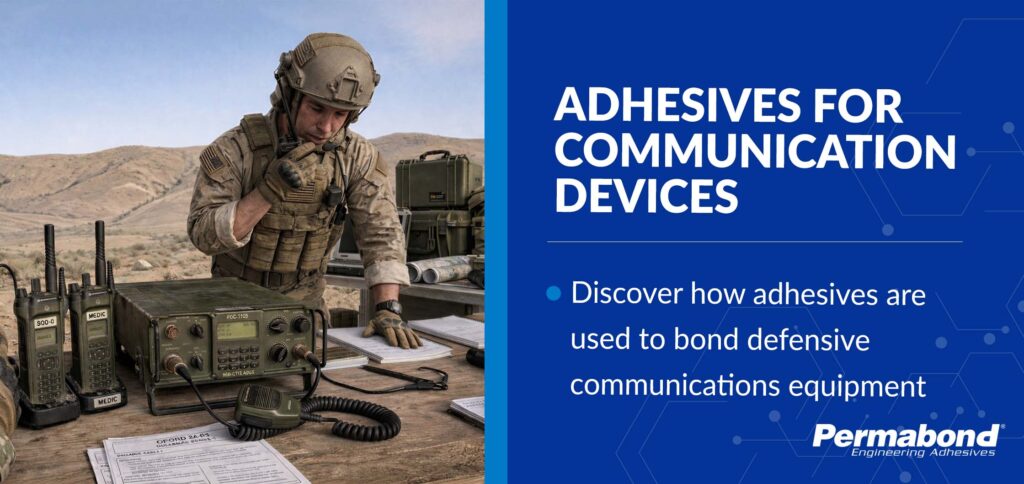
Whether it’s a soldier coordinating operations in extreme heat, a first responder working through torrential rain, or a tactical team operating in dusty desert conditions, ruggedized communication devices are expected to function flawlessly in environments that would quickly overwhelm conventional electronics.
Modern military radios, handheld transceivers, and tactical communication systems achieve this strength and durability through careful engineering, and adhesives play a far greater role here than many people realize. From protecting sensitive electronics to sealing enclosures against the elements, advanced adhesive technologies help ensure reliable communication when mission success depends on it.
Why ruggedized communications equipment faces unique challenges
Environmental Extremes
Military and defense communication devices must withstand:
- Shock and impact from drops and rough handling
- Continuous vibration during transport and operation
- Extreme temperatures
- Water immersion and high humidity
- Dust, sand, and chemical exposure
- Long service lives with minimal maintenance
The cost of failure
Unlike consumer electronics, communication failures in defense applications can have serious operational consequences. This is why every component, material, and assembly process must contribute to reliability.
Adhesives: More than just bonding components
Many people associate adhesives with simple assembly, but adhesives for ruggedized communication devices perform multiple critical functions simultaneously.
Weight reduction and design flexibility
Compared with mechanical fasteners, adhesives can:
- Reduce overall device weight
- Eliminate stress concentrations
- Allow bonding of dissimilar materials
- Support increasingly compact device designs
Enhanced reliability
Properly selected adhesives distribute loads across larger surface areas, helping assemblies better withstand shock, vibration, and repeated mechanical stress.
Protecting electronics from shock and vibration
Securing critical components
Printed circuit boards (PCBs) in handheld radios contain components that can be damaged by repeated vibration or sudden impact.
Adhesives can be used to:
- Secure large components
- Reinforce connectors
- Stabilize wire assemblies
- Prevent movement that could lead to fatigue failures
Surviving harsh operational environments
By reducing mechanical stress on solder joints and electronic components, adhesives for ruggedized communication devices help improve long-term reliability in field conditions.
Environmental sealing and waterproofing
Keeping moisture out
Modern defense radios often require protection against rain, immersion, and humidity.
Adhesives and sealants are used to:
- Seal housing joints
- Protect cable entry points
- Secure display windows
- Prevent moisture ingress around critical interfaces
Dust and contaminant protection
Fine dust and sand can be just as damaging as water. Proper sealing helps maintain performance in desert, industrial, and battlefield environments.
Thermal management in high-performance devices
Managing heat in compact electronics
As communication devices become more capable, power densities increase and thermal management becomes more challenging.
Thermally conductive adhesives can:
- Transfer heat away from sensitive components
- Improve thermal pathways
- Support miniaturized designs
- Enhance long-term reliability
Maintaining performance under stress
Effective heat management helps devices maintain functionality during extended operation in demanding environments.
Display, lens, and housing assembly
Bonding modern interfaces
Displays, protective windows, and optical components are critical elements in today’s communication devices.
Adhesives enable:
- Clear optical bonding
- Improved impact resistance
- Environmental sealing
- Reduced internal reflections
Durable housing construction
Structural adhesives help join metal, plastic, and composite components while maintaining the strength and durability required for ruggedized equipment.
Material compatibility: A critical design consideration
Defense communication devices frequently combine:
- Aluminum housings
- Engineering plastics
- Elastomeric seals
- Glass displays
- Composite materials
Selecting an adhesive that bonds effectively across multiple substrates is essential for achieving long-term performance.
Choosing the right adhesive technology
Selecting an adhesive for ruggedized communication devices is rarely just a matter of choosing the strongest option available. Engineers must balance multiple requirements, including substrate compatibility, environmental resistance, operating temperature range, cure speed, flexibility, and long-term durability. An adhesive used to bond a display window, for example, may require optical clarity and UV resistance, while one used to secure internal components may need excellent vibration resistance and thermal stability.
See below for adhesive chemistries that can be used for bonding ruggedized communications devices.
Epoxies
Epoxies provide high strength, excellent environmental resistance, and long-term durability. They are often selected for structural bonding, component retention, and applications where resistance to moisture, chemicals, and temperature extremes is critical.
Polyurethanes
These offer flexibility and impact resistance for assemblies exposed to dynamic loads. Their ability to absorb shock and accommodate differential thermal expansion can make them well suited to bonding dissimilar materials.
Cyanoacrylates
Cyanoacrylates (also known as superglue) provide fast assembly and rapid fixture times for selected components. These adhesives can be useful where high production efficiency is required, particularly for small parts and precision assemblies.
UV-curable adhesives
UV adhesives cure in the presence of UV light. They ensure rapid processing and precise bonding of transparent components. They are commonly used for display and lens assembly, where optical clarity and controlled curing are important.
Thermally conductive formulations
Thermally conductive adhesives are ideal for heat management and component protection in high-powered electronics. These materials help transfer heat away from sensitive components while maintaining reliable bonds in compact device designs.
Ultimately, the best adhesive choice depends on the specific demands of the application. Factors such as exposure to vibration, ingress protection requirements, service temperature, assembly process, and expected product lifespan should all be considered during the design phase.
Looking ahead: Supporting the next generation of tactical communications
As defense communication devices continue to evolve, designers face increasing demands for reduced size, lower weight, greater durability, and enhanced functionality.
Advanced adhesive technologies will remain a key enabling solution, helping manufacturers deliver ruggedized communication equipment capable of performing reliably in the world’s most challenging environments.
Conclusion
The reliability of ruggedized communication devices depends on far more than sophisticated electronics. Adhesives contribute to structural integrity, environmental protection, thermal management, and long-term durability throughout the product lifecycle.
By addressing multiple engineering challenges simultaneously, modern adhesive technologies help ensure that critical communication systems remain operational when dependable performance matters most.
If you’d like to find out more about our adhesives for ruggedized communication devices or to discuss your application, please contact us.
Vamos discutir seu projeto.
"*" indica campos obrigatórios
Productos

Para encontrar um distribuidor

Os produtos Permabond são vendidos através de distribuidores em todo o mundo.