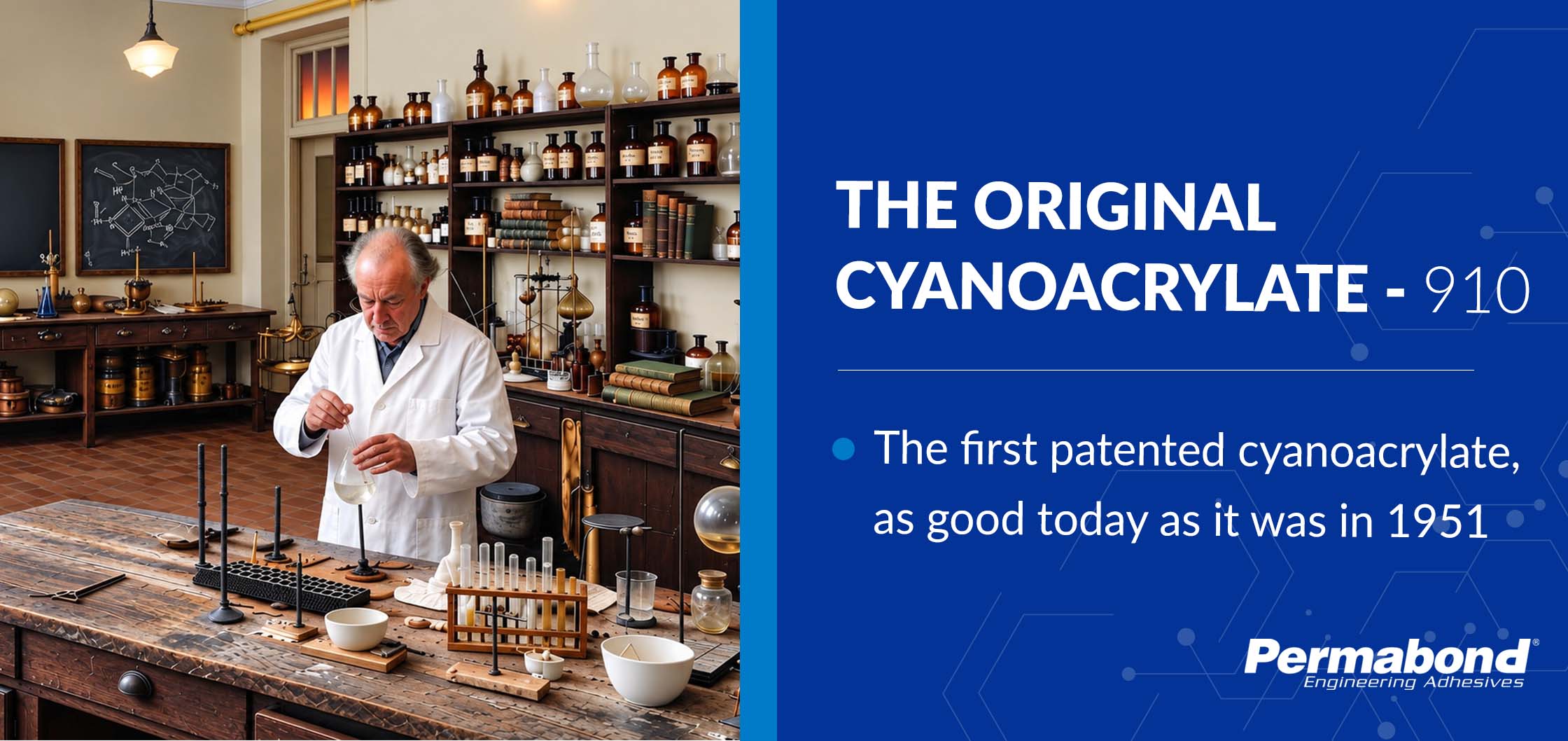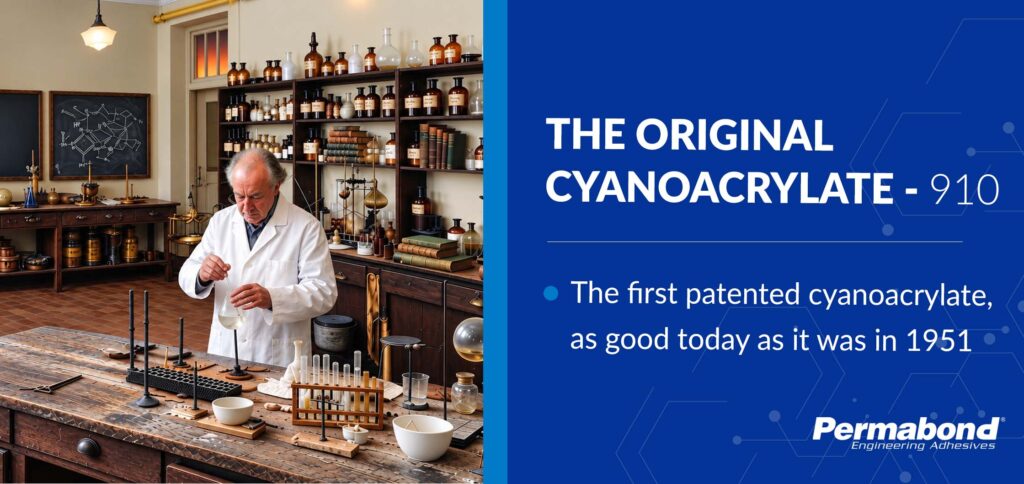
Did you know that Permabond still produces the very first patented cyanocrylate adhesive ever made? Not only are we proud to be continuing in the footsteps of the great inventor of cyanoacrylates, Harry Coover Jr., but Permabond 910 continues to be a standout, widely recommended product in our range today, 75 years after its invention in 1951. Before we explain why 910 remains so popular, allow us to tell you a bit about its history.
The beginnings of superglue
The history of Permabond 910 is fascinating and sheds light on how cyanoacrylates (also known as superglue) came into being. The story begins in 1942 during WWII, when Harry Coover Jr. was part of a team of chemists attempting to make a clear plastic that could be used by allied soldiers for precision gunsights. The chemicals being used here came to be known as cyanoacrylates. However, they were swiftly abandoned because they stuck to almost everything, making them very difficult to work with.
Two years later Coover started working as a chemist for Eastman Kodak, and in 1951 was overseeing a team of chemists researching heat-resistant polymers for airplane canopies. As part of this research, Coover once more thought to test out cyanoacrylates and again, they were found to be too sticky to work with. The inventor was even reprimanded by a colleague for permanently damaging an expensive refractometer by gluing it with cyanoacrylate!
It was during this research, however, that Coover came to understand he’d made an amazing discovery. These glues, unlike others at the time, didn’t require heat or pressure to bond – they just stuck to everything! Continuing his research and refining the product, seven years later in 1958 the original Eastman 910 cyanoacrylate was released to the market. The number ‘910’ comes from the fact that after bonding, by the time you count to 9 or 10, the adhesive will have cured to a solid. Eastman 910 swiftly thereafter came to be commonly known as ‘super glue’ as people became aware of its remarkable bonding abilities.
Coover became somewhat of a celebrity after the launch of Eastman 910. The video below, released after his death in 2011, briefly summarizes his life and achievements.
As good in 2026 as in 1951
You may be wondering why we still make and promote an adhesive that’s 75 years old. Surely newer, more modern products must be better? Well, we consider Permabond 910 to be a bit like the Bic Cristal pen that came out in 1950 – basically, if it ain’t broke, don’t fix it! The formulation of 910 remains unchanged to this day, quite simply because it works so well!
There are, of course, many other cyanoacrylate adhesives on the market that have come out since the original Eastman 910. However, few cyanoacrylates have as high a shear strength on metals as 910 does. If you want an adhesive that offers high strength and rapid strength development on metals like aluminium and stainless steel, Permabond 910 is a very strong, reliable choice.
Excellent adhesion to metals and other substrates
Permabond 910 is a low viscosity, 100% methyl cyanoacrylate. It not only bonds well to metals, but also to other materials like plastics and rubbers. It can be used for bonding dissimilar materials together, for example stainless steel to rubber. Unlike anaerobic adhesives that favor metals with more active surfaces like copper and brass, Permabond 910 forms rapid, strong bonds on a wide variety of metals – with both active and passive surfaces.
Being a methyl cyanoacrylate, Permabond 910 offers a slightly higher temperature resistance than ethyl cyanoacrylates – around 90°C/195°F compared to 80°C/175°F. If your application requires higher heat resistance, please contact us for an alternative.
Because of their fast fixture time, we mainly recommend using cyanoacrylates for bonding smaller parts. If the surface area to be bonded is too big, the adhesive will start to cure before parts are joined.
Specified across industry
Having been around for so long, Permabond 910 has been widely used in a variety of industries since its launch. Over the years it has been specified by companies in aerospace, defense, automotive, heavy equipment, transportation, dental labs, and many other industries. It also has MIL-A-46050C Type I Class 2 (existing designs) & CID A-A-3097 Type I Class 2 (new designs) approvals.
Permabond 910 is a product widely known and trusted by professionals across industrial engineering worldwide. By choosing 910 for your next project, you have the weight of history and decades of successful application on your side.
Key Features of Permabond 910
- The original cyanoacrylate formulation
- Outstanding shear strength on metals
- Good shear strength on plastics and rubbers
- Bonds dissimilar substrates
- Fast fixture time
- Approved for MIL-A-46050C Type I Class 2 and CID A-A-3097 Type I Class 2
- Aerospace approval
- Fast cure (seconds) at room temperature
- Low viscosity; flows readily
- No mixing required
If you’d like to find out more about Permabond 910 or to discuss your project, please contact us.
Kontaktieren Sie uns
Produkte
Technischer Beratungsdienst

Permabond hilft Ihnen, den richtigen Klebstoff für Ihre Anwendung auszuwählen.
Regionale Vertriebshändler

Produkte von Permabond sind über Vertriebshändler in allen Teilen der Welt zu beziehen. Hier können Sie unsere Vertriebshändler finden.