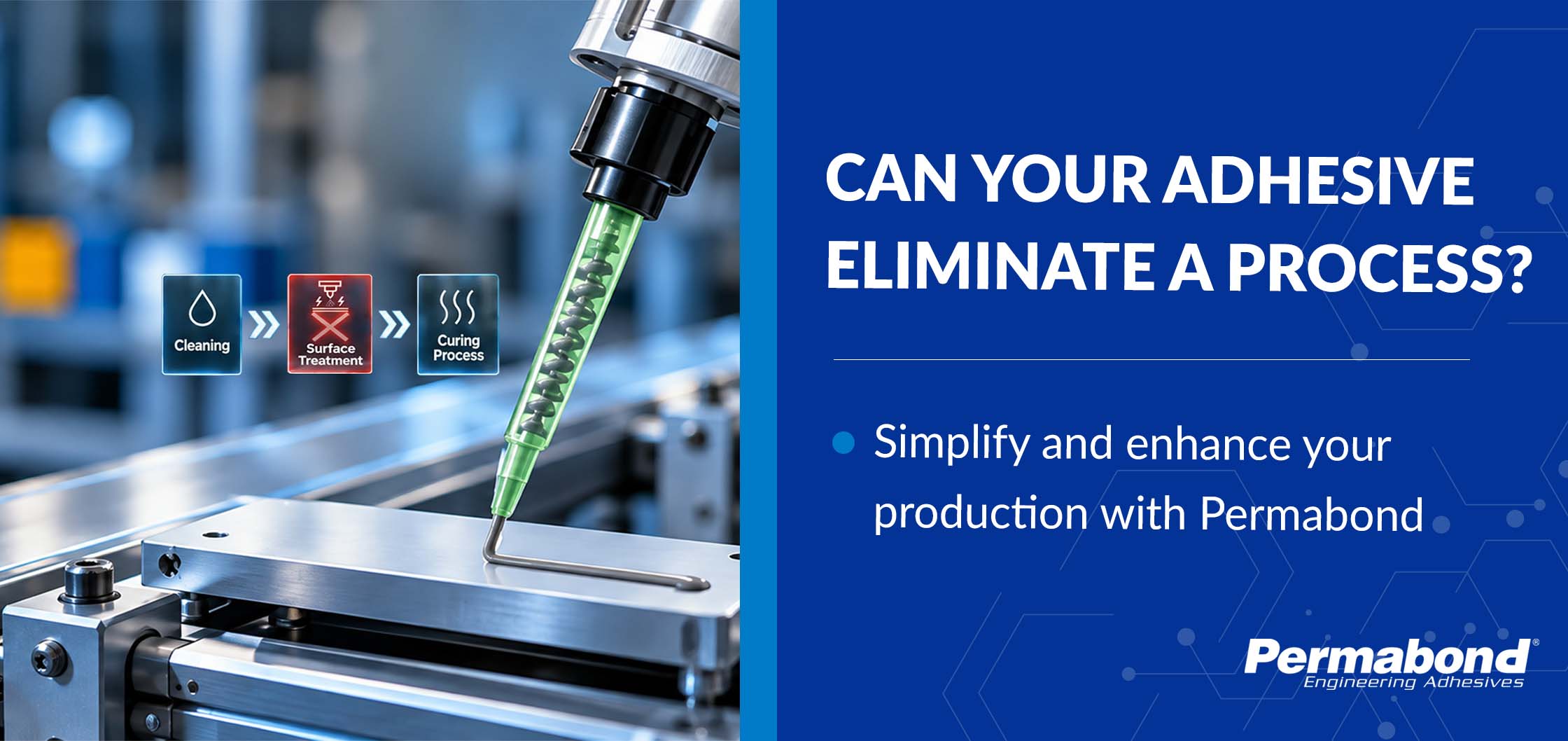
Stand at the end of a typical bonding line and look back along it. The dispenser that actually puts the adhesive down is often one of the smallest things there. Most of the space, and a good share of the cost, goes on surface preparation.. There may be an etch tank and rinse stations for aluminum, a flame or plasma unit for polypropylene, and a booth where solvent primer is sprayed onto parts under overhead extraction.
None of that is there by accident. Surface preparation is often what makes a bond work. But each step brings its own chemicals, energy use, maintenance, and training. Each one is another chance for something to go slightly wrong on a busy shift.
So, when people talk about “safer adhesives”, the conversation is often too narrow. It tends to stop at the adhesive itself: its hazard classification, its labels, and what the safety data sheet says. Those things matter, of course. But it’s worth asking a second question too. If we used a different adhesive, could we stop doing something potentially hazardous to prepare our materials for bonding?
Look past the label
An adhesive’s safety data sheet describes one product. It won’t tell you anything about the acid, the gas burner, or the primer the rest of the process depends on. An adhesive with a slightly worse hazard rating can still leave a factory safer overall, if it lets you switch off a step that was far more hazardous.
That isn’t the same as saying an adhesive can replace any process. Often, it can’t. But whether surface preparation is needed should be considered when an adhesive is chosen, along with strength, cure time, and cost.
Three places where it can make a real difference
1. Bonding aluminum without the acid bath
Aluminum gets bonded a lot, and it isn’t always easy. The oxide that forms naturally on its surface is weak and keeps changing, which is why chemical surface preparation has long been the default. Chromic-sulfuric (FPL) etching and phosphoric acid anodizing both give excellent results. They also need acid tanks, rinsing, neutralizing, and waste treatment, and the older processes use chromates.
Methyl methacrylate based adhesives (MMA) generally bond well to metals without any significant surface preparation. They can bond through light oil contamination and oxide layers to the parent material beneath therefore eliminating the need for extensive surface preparation.
Toughened acrylic adhesives are much less demanding. Take Permabond TA4550. Its data sheet asks for a surface that’s clean, dry, and free of grease. For aluminum, copper, and their alloys, it adds a light abrasion with emery cloth or similar, just enough to take off the oxide layer. Etching isn’t required.
TA4550 is a two-part, 2:1, low-odor toughened acrylic. At room temperature, it fixtures in 5 to 6 minutes and is fully cured after 24 hours. On aluminum, it reaches 24 to 28 N/mm² (3,481 to 4,062 psi) in shear. It also bonds plastics, so an aluminum bracket can go straight onto a nylon part. When Permabond tested aluminum bonded to nylon 6,6, the nylon broke before the bond did, at over 6 N/mm² (870 psi).
If the part lives outdoors
Abrasion on its own won’t always be enough for parts exposed to salt, moisture, or weather. For those, Permabond 2K Primer is worth considering. The surface is still degreased and abraded, then a thin coat of primer is sprayed on before bonding. Compared with running an etch line, it’s a small extra step.
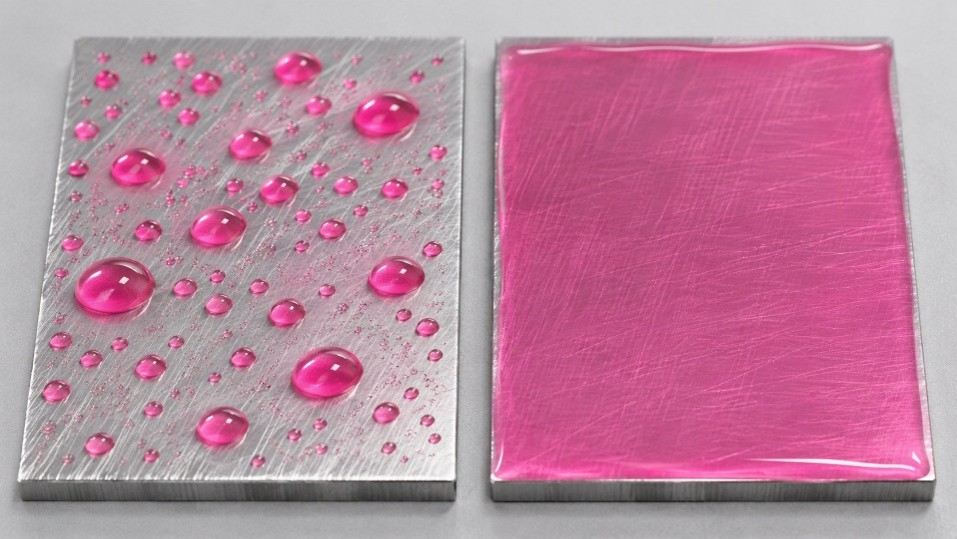
The primer contains an adhesion promoter and helps protect the metal from corrosion. Permabond’s salt spray tests on abraded aluminum, bonded with a structural acrylic, showed better durability when the primer was used. There’s a practical bonus too. The primer is pink, so an operator can tell at a glance whether a part is ready. If it beads up, the surface needs more work. If it wets out flat in an even film, go ahead and bond.
One word of caution. In some industries, especially aerospace, the etch or anodize process is written into the specification. A new adhesive won’t change that on its own, and any change would have to go through qualification.
2. Bonding polypropylene and polyethylene without flame or plasma
Polypropylene and polyethylene turn up in tanks, housings, pipework, and car interiors. Anyone who has tried to glue them knows they are challenging. Their surface energy is so low that most adhesives never properly wet it. The adhesive sits on top, cures, and then lifts off cleanly.
The standard surface preparation is flame, corona, or plasma. It works, but each method needs its own equipment and power, and flame treatment means a naked flame in the factory. The treatment also wears off over time, so parts often must be bonded within a certain window.
Permabond’s TA46XX range bonds these plastics, and it doesn’t need a primer or any surface treatment. These are the shear strengths from the TA4605 data sheet (ISO 4587):
| Substrate | Shear strength | Failure mode |
| HDPE | 15 N/mm² (2,175 psi) | Adhesive |
| Polypropylene | >8 N/mm² (>1,200 psi) | Substrate |
| Polyethylene | >7 N/mm² (>1,000 psi) | Substrate |
| EPDM | >3.5 N/mm² (>500 psi) | Substrate |
| PTFE | 1.5 N/mm² (220 psi) | Substrate |
Substrate failure means the plastic broke, stretched, or deformed before the bond gave way. That was the result on polypropylene, polyethylene, EPDM, and PTFE, so those figures show the limit of the plastic, not the bond. HDPE is the exception. There, the bond itself gave way, which is why its figure is higher than the others.
You do still need a clean part before bonding. Mold release agents are common on molded components, so wipe them with isopropanol (IPA) and let it evaporate completely. That’s the only preparation you need.
There are several grades to suit different lines. TA4605 sets fastest. It’s a thick gel that won’t sag, with microbeads that hold the bond line at a controlled thickness in gaps of up to 1 mm (0.04 in). TA4610 gives you longer to work on bigger parts. TA4611 is clear and thinner, which suits close-fitting joints, and TA4631 has a lower odor. Every grade also bonds metals, composites, and most other plastics.
3. Using less solvent along the way
Shorter surface preparation usually means less solvent. Removing a polyolefin primer takes a solvent-based product out of the building, along with its storage and exposure controls. Removing an aluminum etch often takes the degreasing, rinsing, and neutralizing along with it. And when parts go through fewer stages, operators handle them less and don’t need to re-clean them as often.
Solvents don’t always vanish completely, though. Parts still need to be reasonably clean, and some will still get an IPA wipe. That said, toughened acrylics are better than many adhesives at cutting through light contamination and grease, so depending on the application, solvent cleaning isn’t always necessary. They also carry their own hazards, and some have a strong smell, so read the safety data sheet and make sure the area is well ventilated. The same goes for 2K Primer. What you’re aiming for is less risk across the whole line, rather than one product that’s “safe” on paper.
Testing the change
Here’s how the two routes compare.
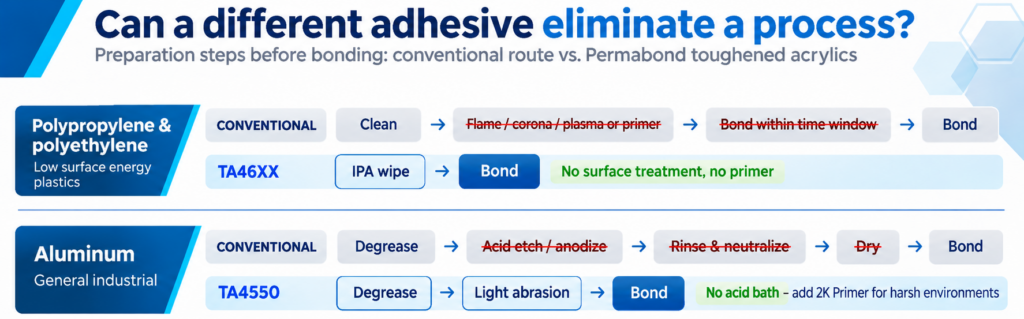
No two production lines are the same, so the only way to find out whether you can eliminate a step is to try it. List everything that happens around the bond: cleaning, treatment, priming, waiting, and inspection. Pick out the steps you’d most like to get rid of. Then bond some real parts both ways, put them through the heat, moisture, chemicals, and loads they’ll face in use, and see how they compare.
When doing this, bear the adhesive’s limits in mind. TA4605 fills gaps of up to 1 mm (0.04 in), works down to -55°C (-67°F), and can affect some thermoplastics, so check compatibility first. TA4550 fills gaps of up to 5 mm (0.2 in).
If the simpler process passes, the benefits go further than the bond. There’s less equipment to run, there are fewer chemicals to store, and the process is easier to keep consistent.
A different way to think about “safer”
The dispenser might be the smallest thing on the line, but what’s in it affects a lot of what happens around it. Judging an adhesive by its hazard label alone only tells half the story. It’s just as useful to ask what surface preparation the adhesive lets you leave out, whether that’s an acid bath, a plasma unit, or a solvent primer. Not every step can go, and you must prove each change on real parts. Where one can, though, you end up with a simpler process and a cleaner factory. That’s a safety gain the data sheet won’t show you.
Thinking about whether a step on your line could go? Permabond’s technical team can help you find out. Tell us what you’re bonding and how you prepare the parts today, and we’ll suggest a grade to trial and help you plan the tests. Whether you’re looking at a single joint or a whole production line, it’s worth a conversation before you invest in new treatment equipment or bring more chemicals onto the shop floor. The simplest process is often the one with the fewest steps, and the right adhesive may be what gets you there. Contact us to talk through your application or to request a sample of TA4550 or the TA46XX range!

Permabond irá ajudá-lo a selecionar o adesivo certo para sua aplicação.

Os produtos Permabond são vendidos através de distribuidores em todo o mundo.
A Permabond é uma empresa certificada ISO QMS.