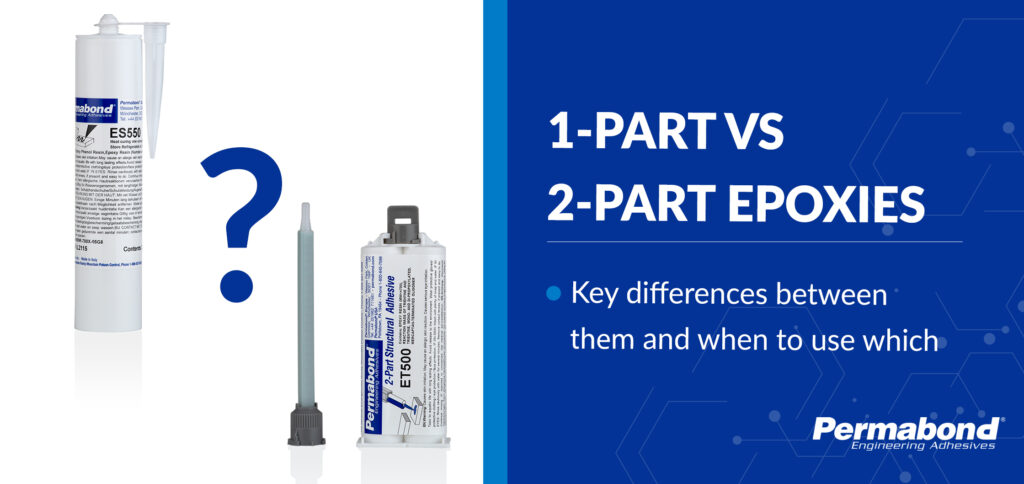
Epoxy adhesives are a highly popular type of glue, mainly due to their strength, durability and versatility, and tend to be available as either a 1-part or a 2-part epoxy. However, you may find yourself struggling to choose between a 1-part and a 2-part product for your application. What’s the difference between these two popular types of adhesives, and when should you choose a 1-part epoxy over a 2-part epoxy, and vice versa? Read on to find out more.
The nature of epoxy glue
All epoxy adhesives – both 1-part and 2-part – actually consist of two constituent parts, namely the epoxy resin and the hardener (also known as a curing agent.) A 1-part (or 1-component/1K) epoxy is so called because its parts have already been pre-mixed, making the glue appear to come as ‘one part.’ A 2-part (or 2-component/2K) epoxy has not been mixed, meaning the epoxy resin and hardener come separately and therefore need to be mixed together before bonding.
Both types of epoxy cure (set) via a chemical reaction between the resin and the hardener. This reaction creates a thermoset plastic once cured – meaning a cured epoxy can’t melt when heated again. Epoxies – both 1 and 2-part – are by nature very strong and durable. In fact, they’re generally the strongest glues you can get! They’re able to withstand a wide variety of stressors such as high temperature, moisture, chemical exposure and impact stress. They’re also quite versatile, able to be used across a wide range of applications. All of these factors combine to make epoxy adhesives a very popular choice in many different industries.
1-part epoxy features, benefits and drawbacks
As mentioned previously, a 1-part epoxy is effectively a 2-part epoxy that has already been mixed together. Since the adhesive has already been mixed at the ideal ratio, it is good to use as received and generates no waste from the mixing process.
The majority of one-part epoxies are designed to remain liquid and stable at room temperature, and have a long shelf life when stored correctly. A key feature of most single-part epoxies is that they require heat to cure, typically done via induction or in an oven at temperatures typically ranging between 80 and 150°C (175 to 300°F). The higher the curing temperature, generally the faster the adhesive will cure. There are also some newer one-part epoxies that are highly reactive and cure at room temperature. These are however less common, as they need to be stored and shipped frozen, increasing end user costs.
The fact they remain stable at room temperature makes 1-part epoxies the best choice for applications where a long open time is required. For example, you may have a large surface area to bond, or a complex design. They tend to be good for automated industrial manufacturing processes, for example in electronics and the automotive industry. However, the necessity of a heat cure can be a drawback if you have delicate or sensitive parts – if this is the case, a 2-part epoxy is likely to be a better choice. The ability to heat cure also requires an investment in machinery that isn’t needed with 2-part epoxies.
Despite being stable at room temperature, some 1-part epoxies will begin to thicken if kept out in the open for a long time. Therefore, we recommend storing your 1-part epoxy glues in the fridge when not in use.
2-part epoxy features, benefits and drawbacks
2-part epoxies come in the form of resin and hardener, and must be mixed before application. If you order a 2-part epoxy from Permabond, these are likely to come in either 50ml or 400ml cartridges. A static mixing nozzle can be put onto the end of these cartridges, meaning when you dispense the adhesive, it will already have been mixed in the nozzle.
This mixing creates a chemical reaction within the adhesive, and unlike one-part epoxies, most two-part epoxies cure fully at room temperature (heat will speed up the cure, however.) This means that they don’t offer the long open time of one-part epoxies, although their individual open time and cure speed varies by product and the mass mixed. They can also be stored at room temperature, requiring no refrigeration.
2-part epoxies are available in a wide range of viscosities (thicknesses) and are ideal for general-purpose bonding jobs. They’re highly versatile and offer excellent bond strength on a wide variety of substrates including metals, composites and many plastics.
1-part vs 2-part epoxy: which is best to use?
This greatly depends on your application. To recap, 1-part epoxies are pre-mixed, need heat to cure, and have a long open time (pot life). On the other hand, 2-part epoxies must be mixed before bonding, cure fully at room temperature and don’t have as long an open time as one-part epoxies. The table below highlights key features of both adhesive chemistries.
| Feature | 1-Part Epoxy | 2-Part Epoxy |
| Curing | Heat-activated | Chemical (room temperature) |
| Ease of Use | Very easy (no mixing) | Requires mixing |
| Storage | Keep refrigerated
|
Store at room temperature |
| Open Time | Very long (at room temp.) | Varies by product |
| Working Time | Short (after heating) | Varies – Adjustable |
| Bond Strength | High | High |
| Equipment | Needs oven or heater
|
None needed
|
| Dispensing | Easy | Easy by hand, automated dispensing more complex due to mixing |
| Typical Uses | Electronics, automotive assembly, heat exchangers, tooling | Construction, repair, composites, marine |
1-Part vs 2-Part Epoxies: Consider your Application
Your specific application is the main thing to consider when choosing between a 1-part and 2-part epoxy. Which materials are you bonding? Would they be able to withstand a heat cure using a 1-part epoxy? How important is a long open time? Do you need a room temperature cure? These are just some of the questions you might ask yourself when choosing the best adhesive. The characteristics of your substrates and application are paramount in making the right choice here. Below, we’ll give examples of some common industrial applications and which epoxy you might use in each case.
1-Part Epoxy Adhesives
Key Traits: Heat-cured (80 – 150°C), ideal for automated, high-precision processes and thin bond lines.
Used In:
Electronics: For die attach and encapsulation – offer consistent quality & high heat resistance.
Automotive: Structural and under-hood bonding – for fast, repeatable results in production lines.
Aerospace: Structural component bonding – 1-part epoxies offer tight process control with heat-cured prepregs.
Consumer Electronics: Small assemblies like casings and heat sinks due to their clean, precise application.
Industrial Equipment: Motors and drives – 1-part epoxies provide stable, uniform curing across batches.
Heat exchangers: Sealing between tubes and endplates.
Tooling: Bonding wear tips such as tungsten carbide, diamond cutting tips.
2-Part Epoxy Adhesives
Key Traits: Room-temperature or low-heat curing, adjustable pot life, bond many materials.
Used In:
Construction: Structural repair and anchoring – 2-part epoxies provide strong, on-site curing.
Marine: Hull and composite repairs – 2-part epoxies cure in humid, salt-rich environments.
Aerospace Repair: Field fixes due to portable, ambient curing & flexible working time.
Consumer & DIY: Versatile household repairs – due to their ease of mixing & various cure speeds.
Industrial / Machinery: Metal and composite bonding – 2-part epoxies provide durable, shock-resistant joints.
Energy: Wind and electrical component bonding, due to their room temperature cure & high stability.
Filters: Potting media into end caps.
In short, 1-part epoxies are highly suited to automated industrial production where heat curing is either already taking place or is readily available. On the other hand, 2-part epoxies are ideally suited to more versatile, on-site jobs where a strong bond at room temperature is required.
If you’d like to find out more about Permabond’s wide range of 1-part and 2-part epoxies or to discuss your application with us, please get in touch!
Kontaktieren Sie uns
Produkte
Technischer Beratungsdienst

Permabond hilft Ihnen, den richtigen Klebstoff für Ihre Anwendung auszuwählen.
Regionale Vertriebshändler

Produkte von Permabond sind über Vertriebshändler in allen Teilen der Welt zu beziehen. Hier können Sie unsere Vertriebshändler finden.