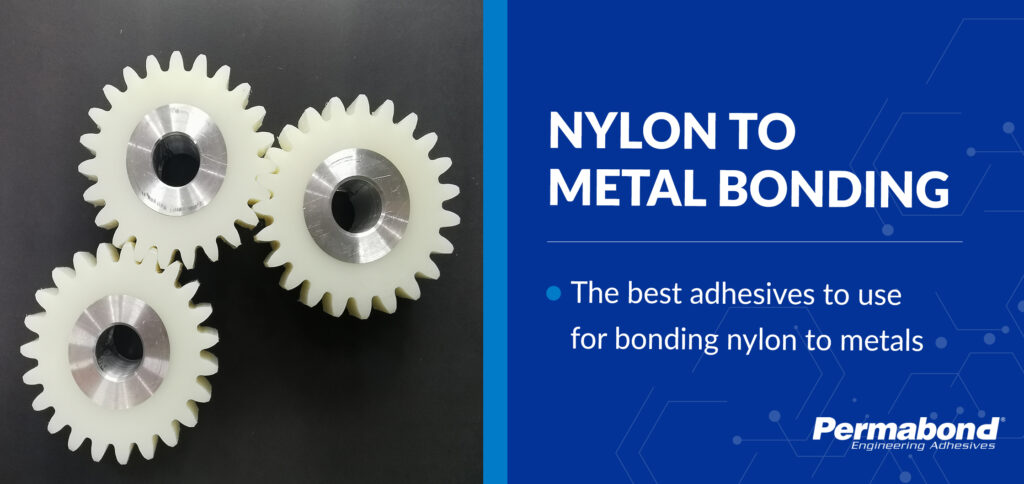
Bonding nylon (chemically known as Polyamide, or PA for short) with adhesives has traditionally been a challenge, as we’ve discussed in previous articles. Key characteristics of nylon which make it tough to bond are its hydrophobicity (resistance to wetting) and hygroscopicity (absorption and internal spreading of moisture from the air around it). Both these factors make it harder for an adhesive to effectively bond nylon and ensure a strong, long-lasting bond.
Bonding nylon to metal, however, introduces a new level of challenge. This is because nylon and metals are fundamentally vastly different materials with opposing chemical characteristics. For example, nylon has a medium surface energy, whereas most metals’ surface energy is very high. This causes uneven surface wetting. Nylon also has much higher thermal expansion and contraction than metals, meaning that changes in temperature can create stress on the adhesive bond as the nylon swells and shrinks more than the metal.
The same is true with moisture absorption – as mentioned earlier, nylon is almost hungry for moisture and will readily take this up from the air around it. Metals, on the other hand, do not. Under humidity nylon can therefore swell as it takes in moisture, leading to stress and even breaking of adhesive bonds. Bonding nylon to metal therefore requires an adhesive that can effectively handle these imbalances in characteristics and still provide a strong bond.
| Property | Nylon | Metals | Effect on Bonding |
| Surface energy | Medium (~40 mN/m) | Very high (> 1000 mN/m) | Makes adhesive wetting uneven |
| Polarity | Moderately polar (amide groups) | Often non-polar or oxidized | Chemical mismatch |
| Thermal expansion & contraction | High | Low | Thermal cycling stresses the bond |
| Moisture absorption | High | Low | Nylon swells with humidity, causing stress at the bond |
Bonding nylon to metal: Is surface treatment needed?
Since nylon can be a bit of a ‘problem child’ for bonding, traditionally it has needed to be surface treated beforehand. Treatments such as plasma and/or flame treatment, as well as corona discharge, can be used to simultaneously raise its surface energy and reduce its hygroscopicity. Improvements in these areas can make bonding nylon to metal easier, as they bring the two substrates closer in chemical alignment. Another common surface preparation method is to ‘dry out’ the nylon before bonding. This can be done by putting it in the oven at 60°C for 2+ hours (ideally overnight) and then attempting to bond. Unlike with other substrates, simply abrading or roughening the surface offers minimal bond strength improvement. It can provide very slightly more mechanical interlocking, but not enough to constitute anything meaningful.
Traditional surface treatment, while effective, can be costly, time-consuming and comes with its own set of risks. Corona discharge creates static, which can attract dust and constitutes a health and safety risk. Flame treatment must be done very carefully to ensure an even treatment and avoid fire risks. Chemical etching, another form of surface treatment, must be done in a fume hood because it is a toxic, corrosive and flammable process.
Thankfully, Permabond has developed an adhesive solution for bonding nylon to metal that allows you to avoid surface treatment altogether.
The best adhesive for bonding nylon to metal
In 2024 Permabond released Permabond TA4550, a two-part structural acrylic designed to bond nylon without the need for surface treatment. TA4550 bonds many types of nylon well, including PA6, 6.6 and 12. It cures rapidly at room temperature and its thixotropy means it doesn’t slump or sag post-application, instead staying firmly in place.
TA4550 offers several benefits for bonding nylon to metals. Of great importance is its flexibility, giving it the ability to both handle thermal expansion and contraction as well as any swelling of the nylon due to humidity or moisture in the air. Other adhesives would embrittle and eventually break under such conditions, but not TA4550.
TA4550 has built-in surface adhesion technology that also allows it to overcome nylon’s hydrophobicity. This means it can fully wet and key into the nylon, ensuring a strong, durable bond. Lastly, TA4550 excels in bonding metals, other plastics and composites, including bonding dissimilar materials – for example, bonding nylon to metal. This makes it a great all-rounder to have in your toolbox for general use, as well as for nylon to metal bonding.
The TA4550 difference
- No surface treatment needed, such as plasma, flame or corona treatment
- Strong bonds – performs well on both nylon and metal, even when bonded to dissimilar substrates
- Full cure at room temperature – no ovens or heating needed
- Works across materials – suitable for a wide variety of metals and nylon types (including filled versions), as well as a wide variety of other plastics and composite materials
- Flexible and able to withstand structural changes in nylon with no damage to the bond
- Excellent temperature, environmental and impact resistance
Application benefits
- Saves time and money through elimination of surface treatment
- Improves reliability of adhesive bonds to nylon
- High performing, offering the structural bond strength needed in demanding industries
TA4550 greatly simplifies the process of bonding nylon and delivers consistent, high-strength performance on nylon-to-metal joints.
Why surface preparation (not treatment) still matters
Although TA4550 removes the need for primers or complex pre-treatments, basic cleaning can still help ensure a stronger bond and more lasting, consistent results. Below are Permabond’s recommendations for preparing nylon and metals before bonding with adhesives.
- For nylon: Wipe with isopropanol to remove oils, grease, or mold release agents.
- For metal: Degrease, lightly abrade or grit blast to remove surface oxidation for best results.
A breakthrough for bonding nylon to metal
Bonding nylon to metal has historically been a difficult task thanks to nylon’s surface properties. Developed specifically for this challenge, Permabond TA4550 makes it easier to create strong, durable bonds on nylon without primers or complex surface pre-treatment.
For manufacturers looking to streamline production while ensuring performance, TA4550 offers a reliable solution.
If you’d like to discuss sampling or to discuss your application with us, please get in touch.
Vamos discutir seu projeto.
"*" indica campos obrigatórios
Productos

Para encontrar um distribuidor

Os produtos Permabond são vendidos através de distribuidores em todo o mundo.