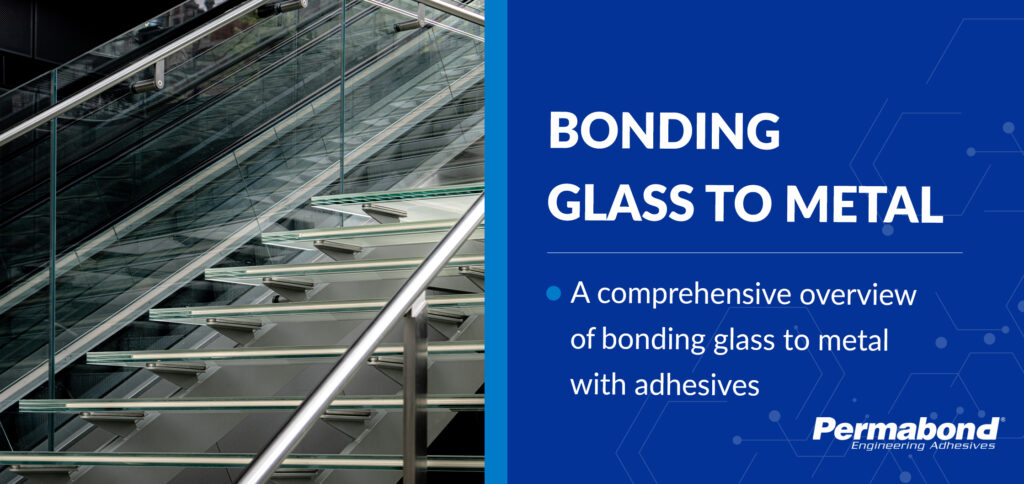
Bonding glass to metal is a common task across a variety of industrial applications. It’s popular in industrial manufacturing, construction, and DIY projects, among others. However, bonding dissimilar materials such as metals and glass can present a challenge for manufacturers due to several factors, which we’ll discuss below. We’ll also help you to decide which glue for bonding glass to metal is best for your project.
Common challenges when bonding glass to metal
When choosing the right adhesive for bonding glass to metal, there are a few important things to consider. Namely, these are differences in thermal expansion and contraction, appearance of the end product and bond flexibility and durability.
Generally, when bonding dissimilar materials such as glass and metals together, a key consideration to bear in mind is differences in thermal expansion and contraction between substrates. Some materials expand with heat and contract with cold much more than others do. How much a material does this is known as its coefficient of thermal expansion (CTE). If two different substrates bonded together expand and contract at very different rates as temperature changes, this can create great stress on the adhesive bond, as it can get stretched out by the expanding substrate. This can lead to embrittlement and even bond failure.
When bonding you ideally want to use materials with a similar CTE. This helps to avoid uneven expansion and contraction when the bond is subjected to thermal cycling or thermal shock. This in turn prevents stress and fractures at the bond area and prolongs the life of the joint.
CTE of glass compared to metals
The table below shows the coefficient of thermal expansion of different types of glass and several commonly used metals.
| Material | Typical CTE (×10⁻⁶ / °C) | Notes |
| Glass (standard) | ~8-9 | Standard glass for windows |
| Borosilicate glass (e.g. Pyrex®) | ~3.3 | Designed for lower expansion |
| Fused silica/quartz glass | ~0.5 | Very low expansion speciality glass |
| Mild steel | ~11-13 | Also known as low-carbon steel |
| Stainless steel | ~15-17 | |
| Aluminium | ~23-24 | |
| Copper | ~16-17 |
As you can see, standard glass has a CTE fairly similar to that of some metals like mild and stainless steel, but there is a greater mismatch compared to others such as aluminium. This needs to be considered when bonding glass to metal, especially when bonding a large surface area. This is because larger surfaces are more likely to lead to stress and bond fractures when exposed to high temperatures or thermal cycling. When bonding smaller parts, differential CTE is generally not so problematic.
You’ll need to bear CTE in mind especially if:
- You have an outdoor application
- Your application involves high temperatures (80°C/176°F+)
- Your application is subjected to thermal cycling (hot/cold cycles) or sudden temperature changes (thermal shock)
- You’re bonding larger parts
To counteract the effects of thermal expansion and contraction, you can use a thicker glue line and a more flexible adhesive. Every Permabond adhesive comes with a technical data sheet (TDS) which indicates its maximum gap fill. When CTE is a factor, you want to have a glue line close to this maximum gap fill value to provide flexibility and absorb stress from expansion and contraction. Parts can be designed to accommodate a thicker glue line with a groove or shim, for example.
End product appearance and bond strength
Since glass is a mostly transparent material, many manufacturers want to avoid any evidence of ‘unsightly’ adhesives in their end product. Glass is often used in applications designed to look attractive, for example in bathroom showers, door assemblies and window frames. Therefore, to ensure the lasting presentation of their product, many manufacturers will ask for a clear, colorless adhesive that doesn’t yellow with aging. Using a UV-light curing adhesive is ideal for such cases, as they are often transparent and don’t yellow. See below for some product recommendations.
Another key consideration is bond strength, taking into account the flexibility and stress absorption mentioned earlier. Certain types of adhesives offer higher bond strength and flexibility than others. However, some types of stronger adhesives aren’t transparent – if strength is your top priority and appearance is secondary or irrelevant, your adhesive choice broadens.
The best glue for bonding glass to metal
There are several types of Permabond adhesives suited for bonding glass to metal. These are:
- UV adhesives
- Structural (toughened) acrylic adhesives
- Epoxy adhesives
UV adhesives for bonding glass to metal
UV light-curing adhesives are a very popular choice for bonding glass to metal. This is because many are colorless, transparent and provide a clean, tack-free finish in seconds. This makes them both very easy to use, aesthetically pleasing and very fast-curing. They also provide high structural strength, are easy to apply, and many do not yellow with aging. Some product recommendations are as follows:
Permabond UV6357
Permabond launched UV6357 in the summer of last year. This is a UV light-curing adhesive that has the extra benefit of being highly resistant to cold environments. Originally developed for a manufacturer of fridge & freezer components, UV6357 provides excellent adhesion on glass and metals, as well as on rigid thermoplastics such as ABS, PVC and Nylon.
UV6357 cures tack-free in seconds. Its outstanding cold resistance enables it to withstand not only low temperatures but also thermal cycling, making it ideal for any applications subjected to frequent changes in temperature, for example outdoors. It offers very high flexibility and toughness and does not yellow with age. Read more about this breakthrough product here.
Permabond UV6231
Permabond UV6231 is a one-component rapid-curing UV adhesive. It offers outstanding optical clarity and excellent resistance to yellowing, making it well suited for high-quality bonding of glass, crystal and other materials. The adhesive also provides strong resistance to moisture and humidity, making it ideal for bathroom applications (such as scales and shower doors) as well as outdoor uses where long-term weathering resistance is required.
Structural (toughened) acrylic adhesives for glass to metal
Structural acrylic adhesives are another option for bonding glass to metal. Some benefits of these adhesives include:
- High Strength & Durability: They form strong structural bonds with excellent tensile, shear, and peel strength.
- Stress Absorption: Acrylic adhesives accommodate differences in expansion and contraction between glass and metal, helping to reduce stress and prevent cracking.
- Versatility: They bond glass to metals, plastics, composites, and other substrates, often requiring minimal surface preparation.
- Clarity (in certain types): Certain acrylics provide outstanding optical clarity, making them ideal for virtually invisible joints in displays and furniture.
Permabond TA4204 is a popular structural acrylic adhesive for glass to metal bonding. This product contains a special adhesion promotor, is colorless and clear, toughened and cures quickly at room temperature. All of this combines to make it ideal for reliable bonding of glass to metal.
Permabond TA4246 is a two-part, no-mix structural adhesive that cures at room temperature. It is suitable for bonding a wide range of substrates including glass to metal, delivering very high-strength structural bonds with excellent resistance to environmental exposure and chemicals. TA4246, when used alongside Permabond Initiator 46, offers high peel strength and outstanding impact resistance, making it a lightweight and durable alternative to rivets or welding. On the other hand, cosmetically speaking the appearance of TA4246 makes it unsuitable if trying to achieve a clear, colorless finish.
For glass to metal bonding with TA4246, apply Initiator 46 evenly onto the metal first. Initiator 46 has a long open time for optimal alignment of parts. Once your parts are properly aligned, apply TA4246 to the glass in a bead (spreading the adhesive is not recommended). After clamping for 2-4 minutes, handling strength is achieved. The combination of TA4246 and Initiator 46 gives a glass-metal bond good environmental resistance, high bond strength and resistance to expansion and contraction.
Epoxy adhesives for glass to metal
Epoxies can also be used for bonding metal to glass. When combined with Permabond 2K Primer, they offer good long-term adhesion and bond strength as well as environmental durability. Epoxies are definitely worth considering when overall strength and durability of the bond are more important than appearance, as many epoxies will yellow with age.
Products to consider include Permabond ET515 (good for bonding dissimilar substrates, handles differential CTE well), Permabond ET5428 (high toughness, impact and temperature resistance) and Permabond ET5393 (high toughness, stress and thermal resistance). However, if bonding long aluminium profiles to glass, the differential lineal expansion and contraction could be considerable – in these cases a thick, flexible sealant would be recommended (e.g. an MS polymer or silicone).
Surface preparation of glass and metal
Before bonding glass, make sure to wipe it clean with isopropanol or acetone and avoid getting fingerprints onto the surface. For metals, first degrease the surface, then lightly abrade it if possible. This will improve the end bond strength. With certain types of adhesives such as epoxies and structural acrylics, you need to use an initiator or primer before bonding to initiate curing.
Other helpful tips
The following are some useful tips for bonding glass to metal:
Avoid point loads: Glass doesn’t handle concentrated stress well. Therefore, make sure that your joint design incorporates even stress distribution. Likewise, if clamping, avoid putting the glass into tension.
Risk of air entrapment: When bonding large glass surfaces, there is a greater risk of air getting into the adhesive. To avoid this, opt for a lower viscosity product for better flow. When clamping, be sure to apply consistent, even pressure across the joint, and lastly, once parts have been assembled, be careful not to shift them in any way. Doing this will help to keep air bubbles out of the newly-bonded joint.
Don’t shake UV adhesives: There is no need to shake your bottle of UV adhesive before applying it – this will create air bubbles in the product. Simply apply as received.
Frequently asked questions for bonding glass to metal
Q: I need an invisible adhesive to bond glass to metal. What type should I choose?
A: In this case we would recommend a UV adhesive such as UV6357 and UV6231. These products are clear, cure tack-free and don’t yellow over time.
Q: Which glue provides the best strength on metal to glass?
A: Two-part epoxies provide very good bond strength between metal and glass, alongside some structural acrylics and specialised UV adhesives. For tailored advice suited to your application, please reach out to our technical team.
Q: Can I use a cyanoacrylate to bond metal to glass?
A: Cyanoacrylates (also known as superglue) can be used to bond metal to glass, but we don’t usually recommend them. This is because while they can bond metal to glass well initially, over time they tend to become weaker. If you need to use a cyanoacrylate, you’ll have more success if you use it on small parts only.
If you’d like to find out more about bonding glass to metal or to discuss your application with us, please get in touch.
Vamos discutir seu projeto.
"*" indica campos obrigatórios
Productos

Para encontrar um distribuidor

Os produtos Permabond são vendidos através de distribuidores em todo o mundo.