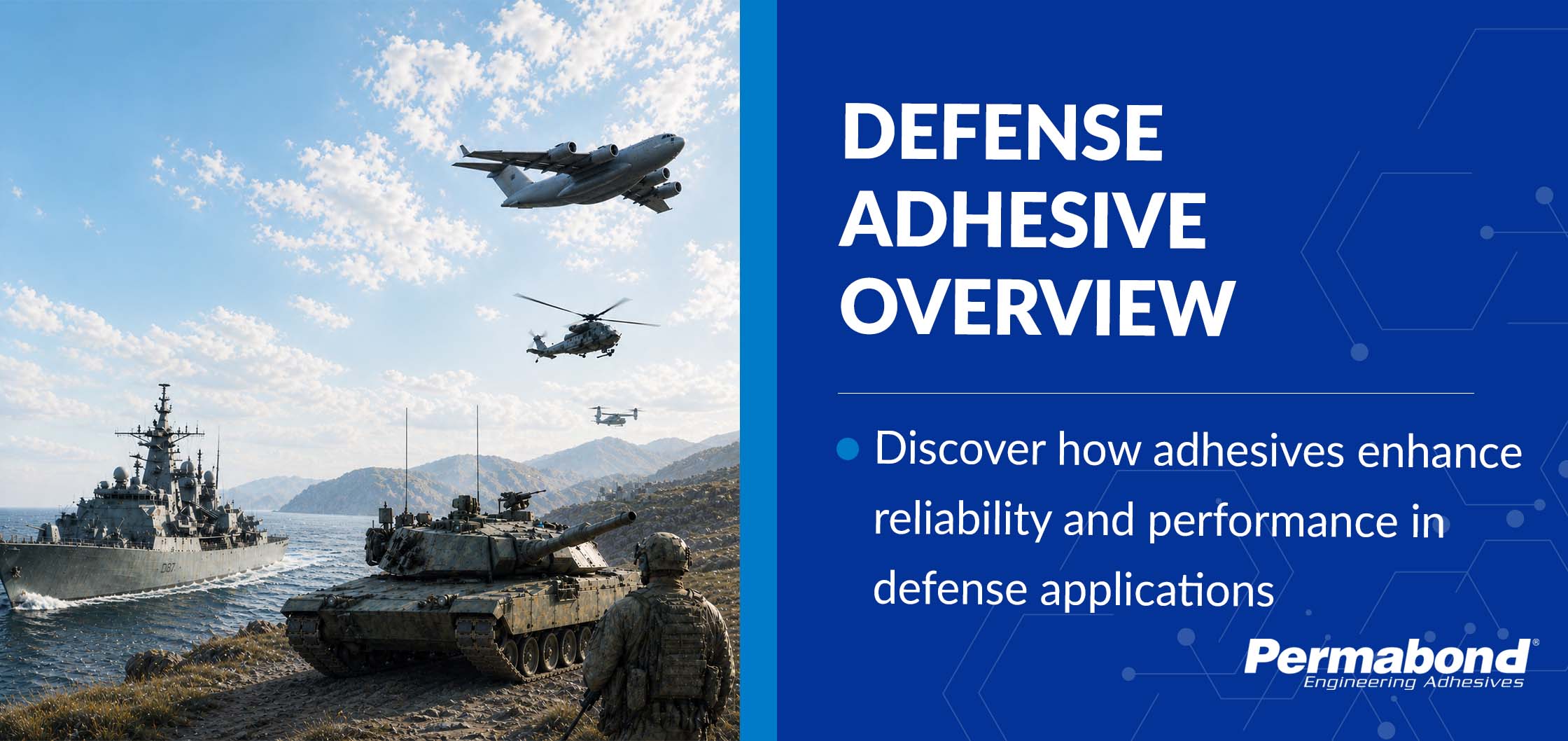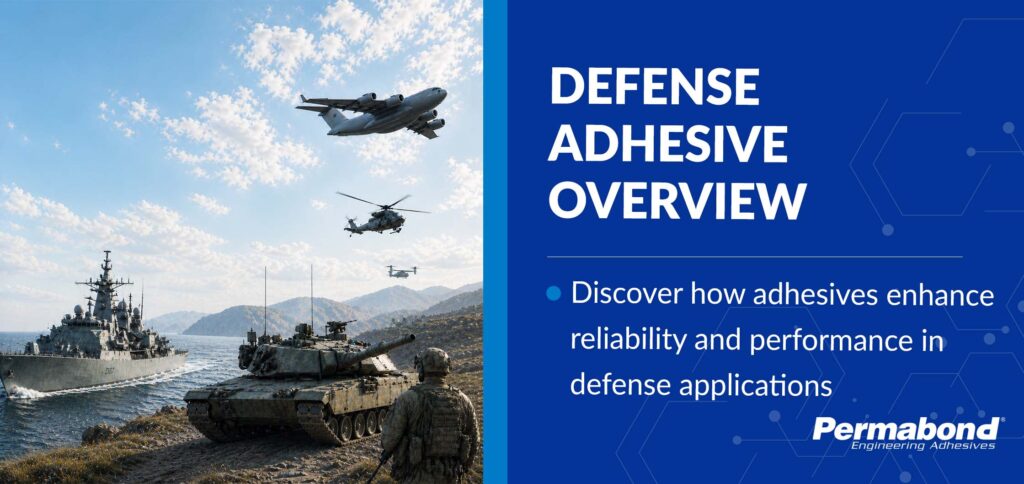
In the context of engineering and manufacturing, defense applications extend far beyond weapon systems. ‘Defense’ broadly encompasses the wide range of equipment and technologies designed to support military operations across land, sea, air, and increasingly, space. To this end, defense and aerospace applications often go hand in hand. These applications include everything from protective gear and armored vehicles to communications infrastructure and life-support systems. At the core of these applications is a shared requirement: absolute reliability under some of the most demanding conditions imaginable.
As defense and aerospace systems continue to evolve in complexity and capability, so too do the materials and assembly methods used to produce them. Among these, advanced defense adhesives play an increasingly critical, if often understated role.
Operating in Extreme Environments
Defense equipment is routinely exposed to environments that would quickly degrade or destroy standard commercial systems. Therefore, durability is a key consideration for manufacturers of products and systems used in the defense and aerospace industry, including in adhesive selection.
Shock and vibration are constant factors to consider, particularly in vehicles, aircraft, and portable equipment. Components must withstand repeated mechanical stress during transport, deployment, and active use without loosening, shifting, or failing.
Temperature extremes present another significant challenge. Equipment may be required to operate reliably in desert conditions exceeding 50°C (122°F), arctic environments well below freezing, or at high altitudes where rapid temperature fluctuations occur. Defense standards require certain products to withstand temperatures down to -55°C (-67°F), for example in the case of single-use flying objects. Materials must maintain their integrity and performance across these wide ranges without becoming brittle, soft, or otherwise compromised.
Moisture and chemical exposure present further challenges. Systems deployed in marine environments must resist salt spray and corrosion, while those in field conditions may encounter fuels, oils, cleaning agents, and other aggressive substances. Dust and particle ingress can also threaten sensitive components, particularly in electronics.
In these environments, the performance of individual materials is only part of the equation. The way components are joined (whether mechanically or through bonding) has a direct impact on overall system durability.
Why Reliability and Long Service Life Matter
Reliability in defense and aerospace applications is not simply a matter of product quality; it is a fundamental operational requirement. Equipment failure can have serious consequences, from mission disruption to safety risks for personnel.
Unlike many commercial systems, defense equipment is often expected to remain in service for extended periods with minimal maintenance. It may also be kept in long-term storage or be mothballed for an extended period before being used. Access to repairs or replacement parts can be limited or impractical, particularly in remote or hostile environments. As a result, assemblies must be designed with long-term performance in mind from the outset.
This places significant demands on joining methods. Traditional mechanical fasteners, while effective in many applications, can be susceptible to loosening under vibration, stress concentration at separate points, and potential pathways for environmental ingress. Over time, these factors can contribute to fatigue, wear, and eventual failure.
Adhesives offer an alternative approach that addresses many of these challenges. By distributing loads more evenly across bonded surfaces, they reduce localized stress and improve resistance to fatigue. In addition, many adhesive systems provide inherent sealing properties, helping to protect against moisture, chemicals, and contaminants.
The result is a more robust and reliable assembly – one that is better suited to the long service life expectations of defense applications.
The Role of Adhesives in Modern Defense Assemblies
As defense systems incorporate increasingly advanced materials and designs, adhesives have become an essential part of the assembly process. Their role extends beyond simple bonding to include sealing, protection, and even functional enhancement.
One of the key advantages of adhesives is their ability to join dissimilar materials. Modern defense and aerospace equipment often combines metals, composites, ceramics, and engineered plastics such as polyethylene and nylon, with each selected for specific performance characteristics. Mechanical fastening methods can struggle with these combinations, particularly where differences in thermal expansion or material properties are significant. Adhesives, by contrast, can accommodate these differences while maintaining a strong and durable bond.
Adhesives also enable more efficient load distribution. Rather than concentrating stress at a limited number of points, as is the case with bolts or rivets, bonded joints spread loads across the entire bonded area. This not only improves mechanical performance but also reduces the likelihood of fatigue-related failure over time.
In addition, many defense adhesive formulations provide environmental resistance as part of their function. They can act as barriers against moisture, chemicals, and particle ingress, contributing to the overall durability of the assembly. In electronics, adhesives are commonly used for potting and encapsulation, protecting sensitive components from vibration, thermal cycling, and environmental exposure.
From a design perspective, adhesives offer greater flexibility. They allow for cleaner, more streamlined assemblies without the need for drilling, welding, or additional fastening hardware. This can contribute to weight reduction – an important consideration in many defense applications – while also simplifying manufacturing processes.
Defense Adhesive Applications
While adhesives are rarely the most visible component in a defense or aerospace system, their impact can be found across a wide range of applications.
Protective Equipment
In protective gear, such as helmets and body armor, adhesives are used to bond composite materials and layered structures designed to absorb and dissipate impact energy. These materials must work together seamlessly to provide effective protection without adding unnecessary weight. Adhesives enable strong, uniform bonds that maintain integrity under repeated stress while supporting lightweight design.
Vehicles and Enclosures
Military vehicles and equipment enclosures, both land- and air-based, must withstand harsh operating conditions while protecting internal systems. Adhesives are used for both structural bonding and sealing applications, helping to create assemblies that are strong, lightweight, and resistant to environmental exposure. Sealing adhesives, in particular, play a critical role in preventing the ingress of water, dust, and chemicals, ensuring that internal components remain protected.
Communications Equipment
Reliable communication is essential in defense operations, and the equipment that supports it must perform consistently under challenging conditions. Adhesives are widely used in the assembly of electronic components, providing vibration resistance and environmental protection. Potting and encapsulation compounds help safeguard sensitive electronics from shock, moisture, and temperature fluctuations, contributing to long-term reliability.
Life-Support Systems
In life-support and related systems, reliability is paramount. Adhesives are used in sealing and bonding applications where failure is not an option, including systems that manage air, fluids, or pressure. These applications often require materials that can withstand significant temperature and pressure variations while maintaining a secure and durable bond.
Enabling the Next Generation of Defense Design
As defense technology continues to advance, the demands placed on materials and assembly methods will only increase. Systems are becoming more integrated, more compact, and more reliant on advanced materials. In this context, defense adhesives are not simply an alternative to traditional joining methods – they are an enabling technology.
By supporting the use of lightweight composites, facilitating the integration of complex electronics, and enhancing overall system durability, adhesives play a key role in modern defense design. Their ability to combine multiple functions – bonding, sealing, and protecting – into a single solution aligns with the broader trend toward more efficient and streamlined engineering approaches.
At the same time, ongoing developments in adhesive chemistry are expanding what is possible. Formulations with improved temperature resistance, faster curing times, and enhanced environmental performance are opening up new opportunities for designers and engineers. For example, the ability to more easily and reliably bond nylon, a material previously challenging to bond with adhesives and often used in drones, expands joining possibilities for manufacturers of these systems.
Conclusion
Defense applications demand a level of performance that leaves little room for compromise. Equipment must operate reliably in extreme environments, often over long service lives and with limited opportunities for maintenance. In this context, every aspect of design and assembly matters.
Adhesives, while often overlooked, are a critical part of this equation. By enabling strong, durable bonds, supporting advanced materials, and enhancing resistance to environmental stress, they contribute directly to the reliability and effectiveness of modern defense systems.
As the industry continues to evolve, the role of defense adhesives is likely to become even more significant – quietly supporting the technologies that underpin defensive capabilities around the world.
To find out about Permabond’s range of defense adhesives, please get in touch with us.
Contactez-nous
Produits
Assistance technique

Permabond vous aidera à sélectionner la colle qui convient à votre application.
Pour trouver un distributeur

s produits Permabond sont vendus par l'intermédiaire de distributeurs dans le monde entier.
Permabond est certifié ISO QMS compagnie.

Vous pouvez obtenir une copie de notre certificat ISO