At Permabond, we don’t only strive to stay at the forefront of adhesive innovation. We also want to make sure that while doing so, we help manufacturers stay at the cutting edge of industrial safety, optimize workplace comfort and keep ahead of the ever-changing regulatory landscape.
In this article, we will explore how adhesive bonding can offer a safer method of joining materials together. We’ll also explore how our products allow manufacturers to do away with potentially harmful industrial practices.
The hidden hazards of traditional joining methods
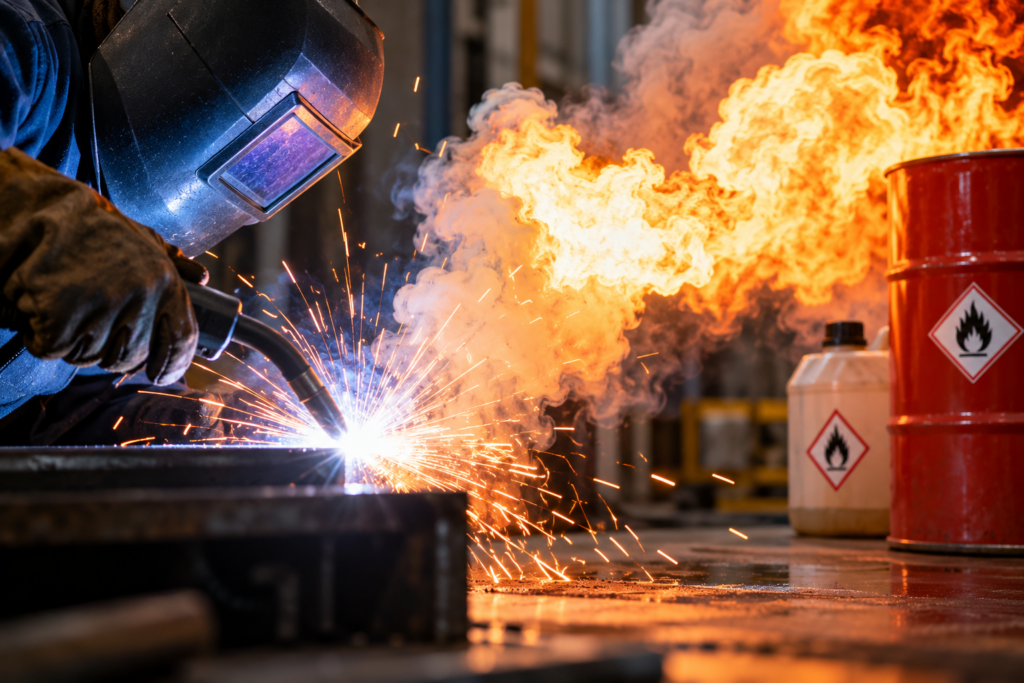
Many industrial surface preparation and joining methods carry inherent risks. Take welding and other heat-based joining methods such as soldering and brazing, for example. There’s a reason that not just anyone is allowed to pick up a welding torch!
Welding involves a combination of extremely high heat and electrical sparks. Modern welding also makes use of oxy-acetylene, a highly flammable and extremely explosive gas. Hot work like welding is tightly regulated worldwide, by OSHA in the US, and under ATEX rules in the EU and UK, where it is heavily restricted in explosive atmospheres.
A close shave
One of our members of staff knows all about the dangers of oxy-acetylene. Her father used to work in a car workshop where welding was regularly carried out. One day, a spark from a welding electrode started a fire at the workshop after coming into contact with fuel vapors.
Knowing that oxy-acetylene was kept on site and fearing the worst, her dad ran into the by then blazing workshop. Miraculously, he was able to secure the oxy-acetylene tanks and bring them outside before they caused an enormous explosion. Now, we’re not suggesting that going into a burning workshop with oxy-acetylene present was wise or remotely in line with good health and safety practice, but his bravery nevertheless can’t be faulted!
It’s not just welding, either
Even manufacturers looking to join parts together using adhesives sometimes still rely on hazardous surface treatment methods to prepare them for bonding. Popular plastics like polyethylene (PE) and polypropylene (PP) have a low surface energy, making them challenging to bond. Historically, manufacturers have turned to methods like chemical etching and flame treatment to raise the surface energy of these plastics and make them more readily bondable.
Both of these treatment methods carry inherent risks. The acids used for chemical etching, such as phosphoric acid and nitric acid, are highly corrosive. They can cause severe chemical burns and release toxic fumes that can cause throat pain and potentially lethal pulmonary edema. Hydrofluoric acid, often used for glass and ceramic etching, destroys nerves and skin tissue and can even dissolve bones!
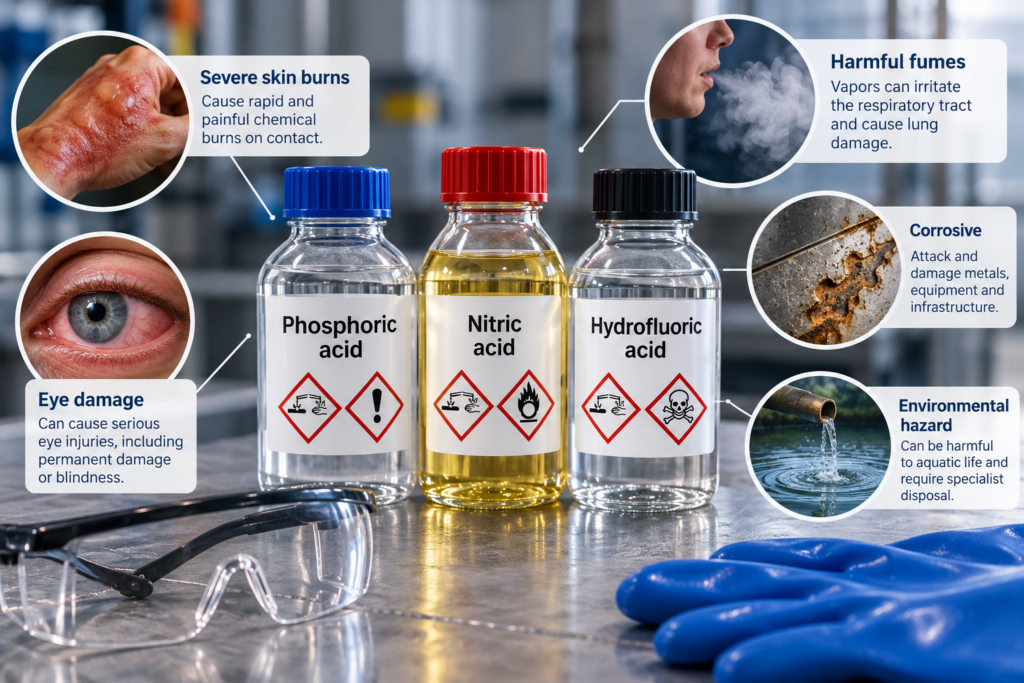
Flame treatment is also used to raise surface energy, especially for polyolefins. This process carries its own dangers – open flames, the risk of thermal burns, and the generation of carbon monoxide from the treatment process itself.
The good thing is that you don’t actually need to carry on with these dangerous processes. When it comes to joining materials together, great alternatives exist that can replace them entirely!
Replacing higher-hazard processes with adhesive bonding
In many cases, welding and other heat-based joining methods can be replaced by adhesives. Structural adhesives can provide similar bond strength to welding, while helping to distribute stress evenly across the whole joint. Adhesives can also do many things that welding can’t – for example, joining dissimilar metals like aluminium to steel.
Safety concerns aside, qualified welders are in short supply in many countries. In the US, Canada, and many European and Asian countries, the demand for welders is outpacing their supply. Perhaps it’s time to turn to adhesives instead!
Skip the polyolefin surface treatment with TA46XX
If you want to bond polyolefins like PE and PP, you don’t need to treat the surface beforehand anymore. The Permabond TA46XX range of structural acrylic adhesives contains breakthrough technology that allows for very strong bonds on these plastics with little more than an isopropanol wipe for surface prep.
Permabond TA4605, TA4610, TA4611, TA4631 and others were all developed to help you bond these challenging plastics with ease. Find out more about these products here.
A proactive approach to chemical regulations: Introducing the UV ‘M’ range
Around the world, manufacturers face ever-evolving chemical safety regulations, such as REACH in the EU and UK, TSCA in the US, and similar frameworks elsewhere.
REACH legislation means that companies have to ensure they are not using substances that are CMR (carcinogenic, mutagenic or reprotoxic) or on the SVHC list (substances of very high concern). These lists are frequently updated, such that a component or material that previously was deemed safe can suddenly find itself on a prohibited list.
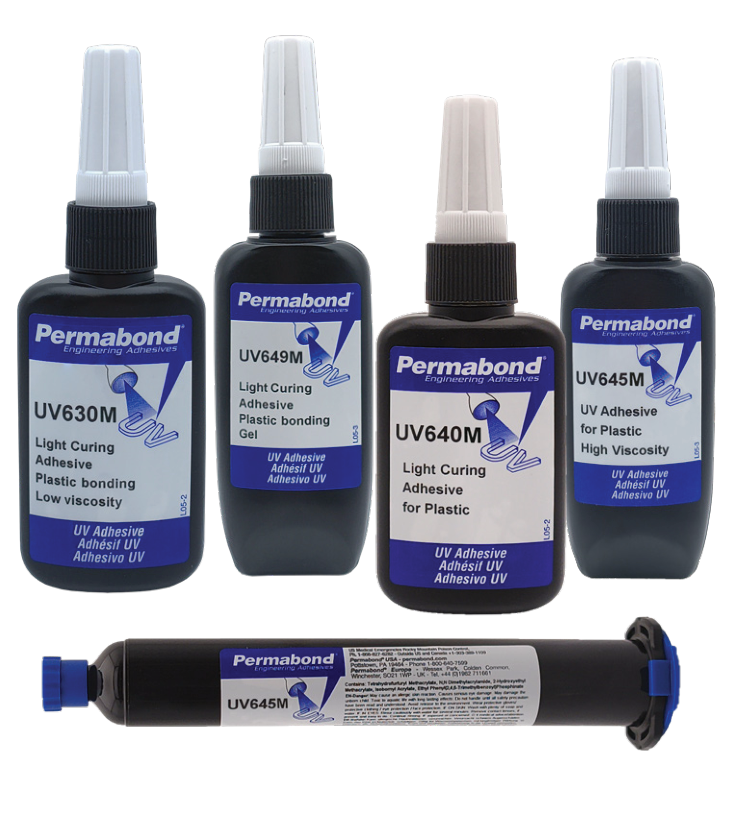
Our newly modified ‘M’ range of UV adhesives came into being for this exact reason. A recent reclassification of a component in some of our UV adhesives prompted us to create this new range – namely Permabond UV630M, UV640M, UV645M and UV649M. These offer the same performance characteristics to existing grades while replacing the reclassified component.
With manufacturing in Europe and customers on every continent, Permabond continuously strives to stay a step ahead of these regulatory changes. Improving health and safety requires continuous formulation development, not simply compliance at one point in time.
‘White label’ adhesives: simplifying compliance
Most industrial adhesives come with a safety data sheet, or SDS for short. On the majority of SDSs, you will notice one or two hazard pictograms. These symbols don’t mean that the adhesive is inherently unsafe to use, but rather show the potential safety risks that need to be considered when handling it. Wearing the correct PPE and ensuring adequate ventilation are usually enough to fully mitigate these risks.
Some adhesives, however, show no hazard pictograms on their SDSs at all. We call such products ‘white label’ adhesives. In the UK and EU, using white label adhesives can help to mitigate the need for a chemical safety workplace assessment, such as COSHH. In the US, products not classified as hazardous under OSHA’s Hazard Communication Standard can likewise simplify labeling and training.
White label adhesives are of interest to manufacturers because they help with safer chemical handling, easier storage as well as employee training and safety. Permabond sells a range of these products worldwide – if these are of interest to you, please contact us.
Beyond workplace safety: PFAS-free adhesive technology
While ‘white label’ adhesives can help to improve occupational health & safety, there is a group of chemicals that harm both humans and the environment that are now getting a significant amount of attention.
Per- and polyfluoroalkyl substances, known as PFAS for short, are a group of man-made chemicals that have been in industrial use since the 1940s. They are known as ‘forever chemicals’ due to their persistence in the environment and are widely considered harmful to human health. Since PFAS can be found in food and drinking water, their presence is coming under increasing scrutiny across many countries.
In the EU, the recast Drinking Water Directive (DWD) sets binding PFAS limits in drinking water that have applied across the bloc since January 12, 2026: 0.1 µg/L for the sum of 20 specific listed PFAS (known as PFAS-20), and 0.5 µg/L for PFAS Total.
The US is moving in a similar direction. In April 2024, the Environmental Protection Agency (EPA) finalized the first national drinking water standard for PFAS, setting enforceable limits of 4.0 parts per trillion for PFOA and PFOS, and limits for four other PFAS. Water systems must complete initial monitoring by 2027.
Since many adhesives come into contact with drinking water and are certified to do so, it’s of paramount importance to us that our products don’t directly or indirectly contribute to the PFAS problem.
Thankfully, most Permabond adhesives are already free from PFAS. In addition, we’ve recently launched more PFAS-free products that are suitable for drinking water applications, such as Permabond LH055. Such products further highlight our commitment to forward-thinking product innovation and development, safeguarding consumers while helping manufacturers to meet their compliance needs.
Making health and safety part of adhesive innovation
At our R&D labs, our product technicians and developers are always looking for the next breakthrough. Not only in bonding innovation, but also in terms of how we can ensure our products are ready for the future, as well as the present.
Health and safety is constantly evolving. Many things that were considered safe 50 years ago are now not, and this may be the same again in 50 years’ time. To stay ahead of this curve, flexibility, open-mindedness and a readiness to adapt are crucial; an approach that we try to adopt as much as possible, even if it’s a little frustrating at times!
Frequently Asked Questions on Adhesive Health and Safety
-
What is a ‘white label’ adhesive?
In the context of health and safety, a white label adhesive carries no hazard pictograms or signal words like ‘warning’ or ‘danger’ on its safety data sheet (SDS). This makes them eligible for a simplified chemical workplace assessment in many countries, as well as easier and safer handling and disposal.
-
Do hazard symbols mean an adhesive is unsafe to use?
No – a hazard symbol on an adhesive label or SDS only indicates the potential dangers of using the product. The most common hazard symbol found on an adhesive is GSH07, denoting an irritant to the skin, eyes and respiratory tract.
The presence of a hazard symbol on an adhesive label or SDS doesn’t mean that it’s inherently dangerous to use. Most issues can usually easily be mitigated by wearing the correct personal protective equipment (PPE). This includes gloves, safety glasses and a lab coat.
It’s also vital to ensure adequate ventilation in the workplace and that adhesives are stored and disposed of safely and correctly. The common sense approach is to remember that adhesives are chemical products, and should be treated as such.
-
Are adhesives safer than welding?
In most cases, using adhesives is far safer than welding or other heat-based methods of joining. This is because adhesives aren’t a fire or explosion risk and don’t involve exposure to high heat, electricity or fuel gas.
-
Do adhesives contain PFAS?
Some adhesives contain PFAS, but many don’t. Considering the increasing scrutiny on PFAS, many manufacturers are actively looking to remove PFAS from their adhesive formulations. Most Permabond adhesives are completely PFAS-free.
If you’d like to find out more about any of our health & safety initiatives, our products, or to discuss your bonding challenges with us, please don’t hesitate to get in touch.

Permabond vous aidera à sélectionner la colle qui convient à votre application.

s produits Permabond sont vendus par l'intermédiaire de distributeurs dans le monde entier.

Vous pouvez obtenir une copie de notre certificat ISO